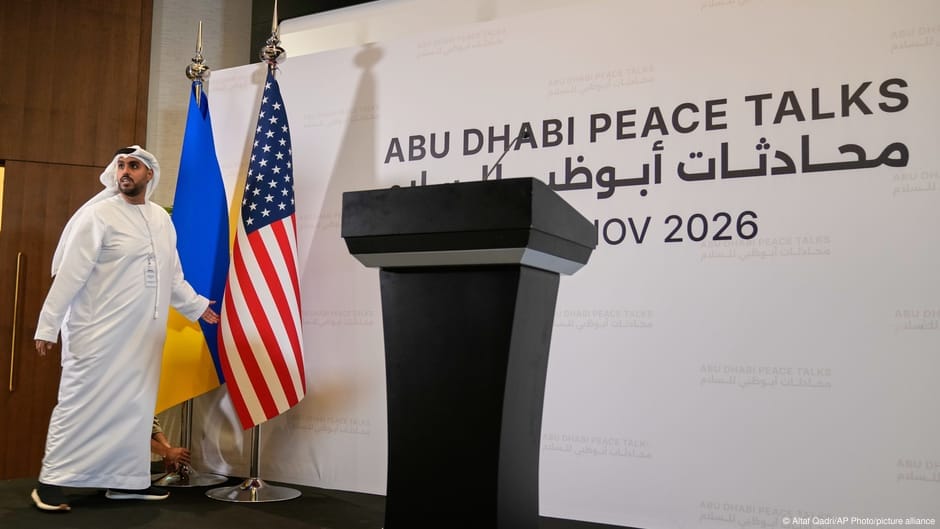
What have the talks with Russia and the US in Abu Dhabi achieved for Ukraine?
0 / 60
English
中文
The first trilateral talks between Ukraine, the US and Russia in nine months have ended with an agreement on exchanging prisoners. Does this mark a genuine breakthrough and a step toward peace?
(暂无翻译) (暂无翻译)
The two-day talks between delegations from Ukraine, the US and Russia in Abu Dhabi on November 10 and 11 ended without a ceasefire agreement.
(暂无翻译)
The main outcome was an agreement on a prisoner exchange.
(暂无翻译)
"We have agreed on the largest humanitarian release of prisoners, and tomorrow we will finalize the numbers," Jared Kushner announced after the talks. US envoys Kushner and Steve Witkoff arrived in Moscow on Thursday, where they are due to meet President Vladimir Putin.
(暂无翻译) (暂无翻译)
Ukrainian President Volodymyr Zelenskyy had earlier suggested an exchange of "1,000 for 1,000" prisoners, or "1,500 for 1,500." Russia said a large-scale prisoner exchange with Ukraine could take place within the next two to three weeks.
(暂无翻译) (暂无翻译)
Following the meetings, Zelenskyy wrote on Telegram that the parties had discussed security guarantees and that "the first step should be ending this war and ensuring Ukraine's security." He also stressed that Europe should be involved "at every stage of genuine diplomacy."
(暂无翻译) (暂无翻译)
Experts interviewed by DW agree that the main outcome of the talks is humanitarian.
(暂无翻译)
"The agreement on a prisoner exchange is already a major step forward," says Artjom Bronzhukov of the Ukrainian think tank Polityka.
(暂无翻译)
Pavlo Lakiychuk of the Ukrainian Center for Global Studies Strategy XXI also viewed it as a "very tangible result." He told DW that "getting our people back is already a major success. That is why it is worth continuing."
(暂无翻译) (暂无翻译) (暂无翻译)
A real breakthrough, he added, would be the release of civilian detainees from territories occupied since 2014, particularly people from Crimea, who have been held in Russian prisons for years.
(暂无翻译)
To view this video please enable JavaScript, and consider upgrading to a web browser that supports HTML5 video Davyd Arakhamia, head of the ruling Servant of the People parliamentary faction and Ukraine's representative at the talks in Abu Dhabi, gave a positive assessment of the trilateral talks with the US and Russia, expressing hope that an agreement could be reached by the end of the year.
(暂无翻译)
"I think the Russians came with extremely strict instructions, and it was difficult to ease the tone of the discussion.
(暂无翻译)
But the way the US representatives structured the talks with a view to the postwar situation in both countries opened up a dialogue, in my opinion, and allowed us to work together more productively," Arakhamia said at a joint press conference with US and Ukrainian representatives following the talks. Iuliia Osmolovska of the Kyiv office of the international think tank GLOBSEC cautions against reading too much into the positive assessments of the talks from Washington and Kyiv.
(暂无翻译) (暂无翻译)
"Diplomats taking part in negotiations will never say that everything went badly and that they have no expectations.
(暂无翻译)
Even when no results are achieved, they will still emphasize that the talks were constructive," she said. "For anyone familiar with diplomatic language, these are simply standard phrases." Osmolovska points to a joint assessment by 71 Ukrainian security and defense experts published by GLOBSEC in the summer.
(暂无翻译) (暂无翻译) (暂无翻译)
According to the assessment, the chances of a peace agreement or at least a ceasefire being reached this year or next stand at just 19%. She blames this on the fact that neither side is "ready" for genuine negotiations.
(暂无翻译) (暂无翻译)
Russia, in particular, has yet to accept that its objectives cannot be achieved by military means. "What we are seeing now is more of a farce, an attempt by all sides to put a brave face on things and create the impression that something is moving forward," Osmolovska said. Artjom Bronzhukov sees the talks as a way for Moscow to buy time.
(暂无翻译) (暂无翻译) (暂无翻译)
"The visits by the Russian delegation, particularly under the leadership of Vladimir Medinsky, are nothing more than an attempt to stall and sell empty promises to the US administration in the form of grand agreements, in order to continue receiving so-called gestures of goodwill from Washington, such as the lifting of sanctions on Russian diesel," the political scientist says.
(暂无翻译)
Ahead of the talks, several Western media outlets reported on new US proposals concerning disputed territories.
(暂无翻译)
The Economist, for example, reported on a proposal to redraw the administrative boundaries of the Donetsk and Luhansk regions. However, a member of the Ukrainian delegation stressed that there had "never been any discussion of concessions on territories occupied by Russia." Washington made no official comment on the reports.
(暂无翻译) (暂无翻译) (暂无翻译)
Kyrylo Budanov, a member of the negotiating delegation and head of the Ukrainian president's office, declined to say whether Russia had used the talks to demand that Ukrainian troops withdraw from the Donbas.
(暂无翻译)
Asked by journalists whether Moscow was still insisting that Ukraine pull out of the region, Budanov said the content of the negotiations would remain confidential until an agreement was reached. "The issues discussed in the talks are matters for negotiation.
(暂无翻译) (暂无翻译)
The only thing that matters is the outcome. Once we achieve it, it will be made public," Budanov said. The head of the Russian delegation, Vladimir Medinsky, took a different tone, declaring that "every inch of our land will be returned to Russia one way or another."
(暂无翻译) (暂无翻译) (暂无翻译)
He was responding to reports in European media that Ukraine was rejecting territorial concessions. In addition to the Crimean Peninsula, annexed in 2014, Russian President Vladimir Putin claims the four Ukrainian regions of Donetsk, Luhansk, Zaporizhzhia and Kherson in their entirety as Russian territory, even though Russia does not have full military control over them.
(暂无翻译) (暂无翻译)
"Putin is not fighting over villages and ruined cowsheds in the Donbas.
(暂无翻译)
He is fighting for geopolitical influence and trying to exploit the collapse of the old world order," says Artjom Bronzhukov. The expert from the Polityka think tank recalls that Ukraine was already asked in early 2026 to withdraw its troops from the part of the Donbas it controls and turn the area into a free economic zone.
(暂无翻译) (暂无翻译)
Such a zone "would very quickly become a Russian-controlled area," he warns. To view this video please enable JavaScript, and consider upgrading to a web browser that supports HTML5 video Pavlo Lakiychuk questions the idea of changing administrative boundaries.
(暂无翻译) (暂无翻译)
"Why would Putin stop there?"
(暂无翻译)
asks the expert from the Strategy XXI center.
(暂无翻译)
In his view, US negotiators are seeking to extract unilateral concessions from Ukraine "step by step" without demanding anything in return from Russia. Iuliia Osmolovska describes the proposal as "very original," but says it would pose risks for Ukraine's leadership. Even if the Ukrainian delegation agreed to it, which Osmolovska doubts, the decision would have to be explained to the public, which, she says, is not ready to accept it.
(暂无翻译) (暂无翻译) (暂无翻译)
The GLOBSEC expert points out that, following the last harsh winter, marked by shortages of electricity and heating, only 5% of Ukrainians were willing to make concessions to Russia in exchange for an end to attacks on the energy sector. Following the meeting between Jared Kushner, US special envoy Steve Witkoff and Vladimir Putin in Moscow, Volodymyr Zelenskyy said he wants to "coordinate positions with the Americans once again."
(暂无翻译) (暂无翻译)
No further trilateral meetings have been announced so far.
(暂无翻译)
Iuliia Osmolovska believes the parties will sooner or later have to admit that the negotiations have reached a dead end. She expects each side to return to military action.
(暂无翻译) (暂无翻译)
Pavlo Lakiychuk, by contrast, believes the talks should continue, if only to secure the return of prisoners. He is also convinced that Europeans "will always be there," because the issue is not just the Russian-Ukrainian war but the security of the entire continent.
(暂无翻译) (暂无翻译)
This article was originally published in Ukrainian.
(暂无翻译)
仅供学习使用,如有侵权请联系删除 · 查看原文