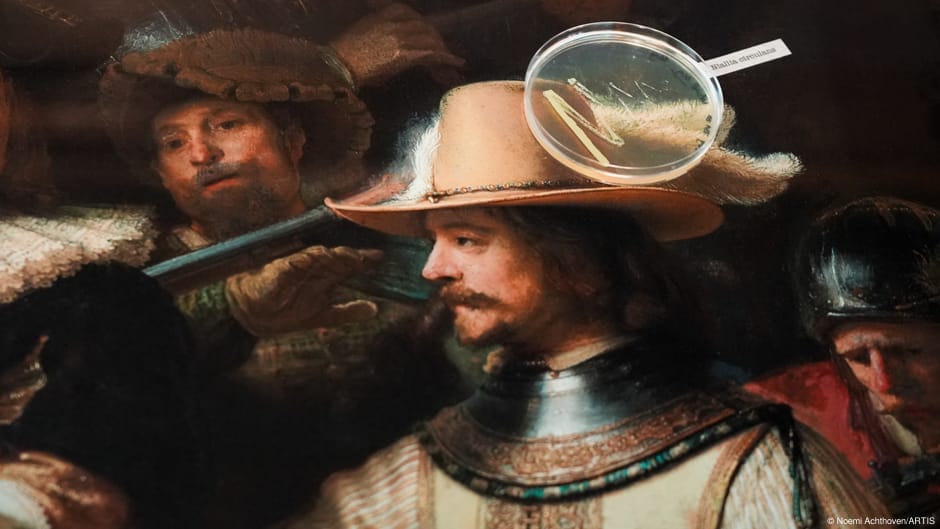
Rembrandt's 'The Night Watch' is more alive than you'd expect
0 / 39
English
中文
A new project and exhibition, "The Night Watch Lives," lifts the veil on the hidden world of microbes covering one of the most famous paintings of the Dutch Golden Age.
(暂无翻译)
Rembrandt van Rijn's "The Night Watch" is one of the most famous paintings of the Dutch Golden Age. Amsterdam's Rijksmuseum, where the work is on display, hails the artist's 1642 masterpiece as "the turning point in his career and as the superlative example of his creative genius."
(暂无翻译) (暂无翻译)
In the painting, Rembrandt made dramatic use of light and shadow to guide the viewer's eye to key figures. And unlike static group portraits typical of his era, the artist depicted Amsterdam's civic guards in mid-action, as they prepare to march out.
(暂无翻译) (暂无翻译)
Beyond the sense of movement featured in "The Night Watch," the painting itself is also alive in a way that's rarely taken into consideration — through the microscopic organisms living on the canvas.
(暂无翻译)
The research project "The Night Watch Lives" explores exactly that question: What kinds of life forms inhabit the surface of the famous painting?
(暂无翻译)
The study is a collaborative scientific and exhibition project between the Rijksmuseum and ARTIS-Micropia — an Amsterdam museum dedicated to the world of microorganisms.
(暂无翻译)
It's part of the broader "Operation Night Watch" restoration and research project described as the "biggest and most wide-ranging ever study and restoration of Rembrandt's most famous painting," started in 2019. Conservators and scientists in this project have been examining every aspect of Rembrandt's masterpiece using cutting-edge technology, seeking new insights into its materials, condition and history — and now, its microbiome.
(暂无翻译) (暂无翻译)
The idea behind "The Night Watch Lives" was to "put microbes in a positive spotlight," Eline van Bloois, who led the research, told DW. "Honestly, if you're asking me — I'm a microbiologist, so I'm biased of course — but they really deserve more positive attention."
(暂无翻译) (暂无翻译)
Over a period of six months, van Bloois will be taking samples once a month directly from the famous painting at the Rijksmuseum, accompanied by the people working on the restoration of "The Night Watch."
(暂无翻译)
Using small sterile discs gently pressed against selected areas of the painting, the samples collect microscopic material from both varnished and unvarnished sections.
(暂无翻译)
These samples are then cultivated in laboratories, allowing previously invisible microbes to grow into visible colonies that can be studied and identified.
(暂无翻译)
At the "The Night Watch Lives" exhibition, visitors can view Petri dishes containing the cultivated microbial colonies. A life-size reproduction of Rembrandt's masterpiece also shows where the samples were taken, and which microorganisms were found there.
(暂无翻译) (暂无翻译)
At the exhibition's opening on November 11, the installation included the findings of two of van Bloois' sampling sessions. Four more will be added over the coming months, allowing the museum's visitors to follow the results of the study as it unfolds.
(暂无翻译) (暂无翻译)
That means the exhibition's visitors "will be figuring out what I've found as I'm figuring it out myself," explains the microbiologist. "We really take them through that journey with us."
(暂无翻译) (暂无翻译)
People often fear microbes or associate them with disease, even though the vast majority of these microscopic organisms are actually harmless or vital to human survival.
(暂无翻译)
Some of the organisms found on the painting "are very commonly found on human skin, for instance, and they're a healthy part of the microbiome; most humans actually have these bacteria with them," says van Bloois, adding that the presence of these microbes on the painting made sense, since humans are often near the work.
(暂无翻译)
But another bacterium stood out in the samples: Microbacterium saccharophilum, a species first identified at a sugar refinery in Japan in 2013. How this microorganism ended up on the Dutch "Night Watch," or when, is a guessing game.
(暂无翻译) (暂无翻译)
"It's part of the fun and part of the frustration in microbiology. You cannot ask the microbes where they originate from," says van Bloois. "It would make our lives a bit easier, but it's also fun to have a little bit of a mystery."
(暂无翻译) (暂无翻译) (暂无翻译)
The samples also revealed bacteria from soil, often found in plant roots. Could these organisms somehow harm the painting? Could plants start growing on the work?
(暂无翻译) (暂无翻译) (暂无翻译)
Van Bloois explains why this is highly unlikely: On the painting, the bacteria can form inactive spores, but for the study, the researcher "provided them with all the nutrients and the right temperature and the right humidity that allowed them to grow again."
(暂无翻译)
Still, studying these organisms may eventually contribute to understanding how paintings age, how environmental conditions affect cultural heritage, and how museums can better preserve priceless works of art.
(暂无翻译)
As to whether the microorganisms could date back to Rembrandt's time, the microbiologist says that's also "highly unlikely" — but here again, microbes cannot reveal their origin story.
(暂无翻译)
As part of the larger "Operation Night Watch" team, van Bloois is definitely inspired by this "group effort where everyone is just really enthusiastic about telling these stories and adding to the knowledge surrounding 'The Night Watch.'" The microbiological samples revealed by the laboratory process resemble abstract art in miniature: colorful clusters, delicate textures and intricate patterns created by living organisms.
(暂无翻译)
And as the study is unfolding publicly, it also feels like an artistic performance of its own.
(暂无翻译)
The project also perfectly embodies the full name of the museum where the exhibition is held: Natura Artis Magistra, a Latin phrase that translates to "nature is the teacher of art and science," as the microbiologist points out: "It's really cool to see science and art all come together in this project."
(暂无翻译)
The exhibition "The Night Watch Lives" runs at ARTIS-Micropia in Amsterdam until the end of May 2027.
(暂无翻译)
To view this video please enable JavaScript, and consider upgrading to a web browser that supports HTML5 video
(暂无翻译)
仅供学习使用,如有侵权请联系删除 · 查看原文