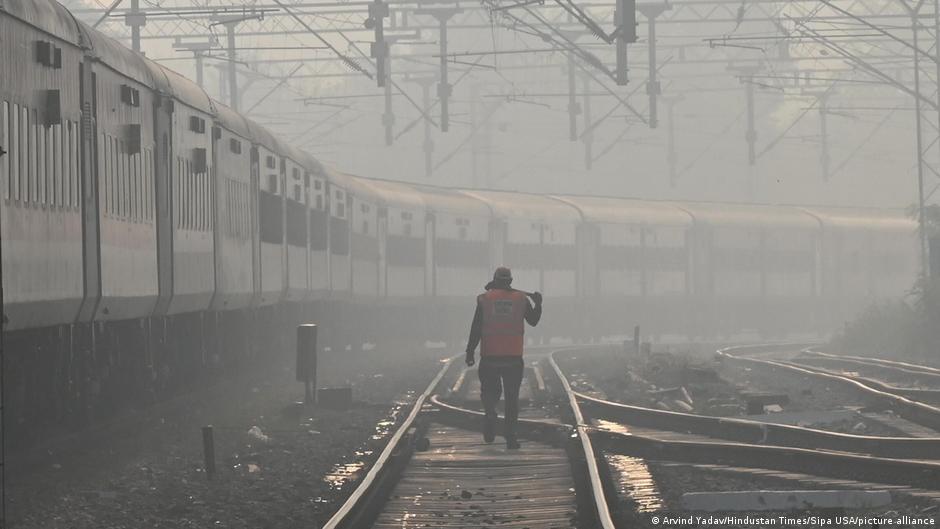
'No choice but to bear it': Delhi's unrelenting air pollution crisis
0 / 62
English
中文
Despite years of government interventions, emergency restrictions and public outrage, Delhi continues to battle dangerously polluted air every winter. Why isn't there a lasting solution to a predictable crisis?
(暂无翻译) (暂无翻译)
On a slightly chilly and distinctly smoggy morning in New Delhi, Khushboo Arora was looking for another air purifier for her mother, who has underlying health complications, before the city's air quality deteriorated further.
(暂无翻译)
"Already, I am starting to get a recurring headache," she said. "These days when I wake up, I don't feel fresh. As the day progresses, I feel a heaviness in my head, itching in my eye and a constantly parched throat."
(暂无翻译) (暂无翻译) (暂无翻译)
Not long ago, the unpacking of woolens announced the advent of winter in Delhi. Now, it's the light hum of an air purifier in the corner.
(暂无翻译) (暂无翻译)
Arora said she has already stopped doing yoga in the park and taking her morning walks. She has also filled her house with air-purifying plants and started spraying water mist inside the house to bring down the level of pollution.
(暂无翻译) (暂无翻译)
"My parents look at me like I have gone mad. But I feel people are not realizing the gravity of the situation," she said.
(暂无翻译) (暂无翻译)
Winters in Delhi increasingly follow a familiar pattern: Air quality deteriorates, residents struggle to breathe, emergency restrictions kick in and governments exchange blame. Then the season changes, only for the cycle to repeat the following year.
(暂无翻译) (暂无翻译)
On Thursday, Delhi's air fell into the "Very unhealthy" category, according to Swiss air quality monitor IQAir, with an average PM2.5 concentration of 157.9 micrograms per cubic meter of air. The World Health Organization (WHO) recommends an annual safe limit of no more than 5 micrograms.
(暂无翻译) (暂无翻译)
Studies have shown that exposure to PM2.5 — air particles with a diameter smaller than 2.5 micrometers that can penetrate deep into the lungs and enter the bloodstream — is associated with an increased incidence of head and neck cancer (HNC), like oral, nasal and throat cancers.
(暂无翻译)
But despite years of attempted interventions, India's capital continues to struggle with the same pollution crisis.
(暂无翻译)
Delhi is not dealing with an unknown problem. There is considerable scientific understanding of its causes.
(暂无翻译) (暂无翻译)
A 2026 assessment by an expert panel reviewed by the Delhi government identified the major winter contributors of PM2.5 as vehicular emissions, industrial activity, road and construction dust, biomass and waste burning, and pollution from neighboring regions.
(暂无翻译)
Sunil Dahiya, founder of the environmental group EnviroCatalysts, said Delhi is part of a larger airshed. On most winter days, more pollution comes into Delhi than is generated inside it, according to the environmentalist.
(暂无翻译) (暂无翻译)
"Analysis of the government's Decision Support System (DSS) data for winter 2025 found that around 65% of Delhi's PM2.5 came from outside the city and about 35% from sources within it," he told DW, adding that neighboring Noida and Gurugram, which comprise the National Capital Region (NCR), are some of the biggest contributors.
(暂无翻译)
Coordinating action across the NCR, which spans Delhi and parts of three neighboring states, remains a major obstacle.
(暂无翻译)
"This is a shared problem, and no single city can solve it alone," Dahiya said.
(暂无翻译)
To understand why existing policies have not delivered sustained improvements, Dahiya highlighted the gap between scientific recommendations and state action.
(暂无翻译)
"Scientists have said for over a decade that we need airshed-wide, year-round, source-specific action. What we mostly get is seasonal and reactive," he said.
(暂无翻译) (暂无翻译)
According to the environmentalist, emergency restrictions kick in only after pollution has reached dangerous levels. Short-term measures such as water sprinklers and smog towers provide little relief, while bigger structural changes are slow to materialize. These include stricter enforcement of industrial emissions, cleaner fuels, expanded public transport, vehicle electrification and viable alternatives to crop burning for farmers.
(暂无翻译) (暂无翻译) (暂无翻译)
"The science is not the bottleneck. Implementation, regional coordination and political will are," said Dahiya. "Until targets are tied to emission reductions at each source, and someone is held accountable for meeting them, we will keep having the same conversation every November."
(暂无翻译) (暂无翻译) (暂无翻译)
Bhavreen Kandhari, co-founder of Warrior Moms, agrees that official responses focus on reacting rather than preventing.
(暂无翻译)
"They allow pollution to occur and then try to clean it up — producing nice photo opportunities of water sprinklers and smog guns, or talking about cloud seeding," Kandhari told DW. "Creating pollution only to clean it up later is a waste of public funds, time, and health."
(暂无翻译) (暂无翻译)
Kandhari also added that incinerating waste instead of proper waste management has only exacerbated the situation.
(暂无翻译)
Another obstacle to a lasting solution has been the political blame game that starts as soon as the air quality worsens.
(暂无翻译)
On Thursday, Delhi Environment Minister Manjinder Singh Sirsa said stubble-burning in the neighboring state of Punjab is contributing to the capital's rising pollution, according to public broadcaster All India Radio. He insisted that in Delhi, construction, vehicle and industrial sources were controlled.
(暂无翻译) (暂无翻译)
Dahiya agreed that seasonal crop-burning fires in neighboring states of Punjab and Haryana "is an episodic but sharp contributor" which "can tip 'very poor' air into 'severe'" for a few weeks. But it is not the lone contributor.
(暂无翻译) (暂无翻译)
"Among sources within Delhi, vehicles alone contribute roughly 51-53% of local PM2.5. A large share of winter PM2.5 is also secondary particulate formed from gases like sulfur dioxide, nitrogen oxides and ammonia," Dahiya said. "That points straight back to combustion in power plants, industry and transport."
(暂无翻译) (暂无翻译) (暂无翻译)
"If stubble burning ended tomorrow, Delhi would still breathe unhealthy air for most of the year," he added.
(暂无翻译)
DW reached out to several Delhi government officials for a response, but received no reply.
(暂无翻译)
Delhi is also home to millions of people who cannot afford air purifiers and have no escape from the toxic air.
(暂无翻译)
Among them is Deepika, who works as domestic help in an affluent South Delhi neighborhood. She has been coughing for a week.
(暂无翻译) (暂无翻译)
"I have no choice but to bear it for the next few months."
(暂无翻译)
The people DW spoke to point to a common set of priorities: Addressing Delhi's pollution crisis requires year-round pollution control rather than seasonal restrictions, better coordination between governments and stronger enforcement of existing regulations and measurable targets. They say the city needs a sustained clean-air strategy more than another winter emergency plan.
(暂无翻译) (暂无翻译)
Namrata Yadav is a Delhi resident and the mother of an eight-year-old boy. They both joined protests against air pollution in November. A year later, the problems persist.
(暂无翻译) (暂无翻译) (暂无翻译)
"It is exhausting to repeat the same things year after year, only to be dismissed as paranoid or alarmist for demanding something as basic as clean air," she said.
(暂无翻译)
Calling for lasting solutions driven by science, policy and accountability, Yadav said: "We have spent years learning how to live with pollution. It is time we demanded that those responsible learn how to end it."
(暂无翻译) (暂无翻译)
To view this video please enable JavaScript, and consider upgrading to a web browser that supports HTML5 video
(暂无翻译)
仅供学习使用,如有侵权请联系删除 · 查看原文