Kosovo: Outrage as authorities accused of not helping femicide victim
0 / 57
English
中文
Despite reporting her husband to the police and pleading for protection, Arlinda Zekaj was brutally murdered. Now, thousands in Kosovo are protesting what they say is a dramatic failure of state institutions.
(暂无翻译) (暂无翻译)
Arlinda Zekaj repeatedly asked the Kosovo police for protection. They said she was exaggerating.
(暂无翻译) (暂无翻译)
On October 25, the 49-year-old once again reported her husband to the police. This time, he was arrested. But Zekaj also asked the police for additional protection — this time against her husband's family. But to no avail.
(暂无翻译) (暂无翻译) (暂无翻译) (暂无翻译)
The police drove Arlinda Zekaj home. Her killer was waiting. At 8:58 p.m., Zekaj got out of the squad car. A short time later, the police received an emergency call. When officers arrived at Zekaj's house at 9:10 p.m., they found only her body.
(暂无翻译) (暂无翻译) (暂无翻译) (暂无翻译) (暂无翻译)
The 49-year-old had been brutally murdered in her bedroom with an axe. By that time, the alleged perpetrator — her brother-in-law, Albert Sylaj — had fled.
(暂无翻译) (暂无翻译)
The murder, which took place in the village of Vitomirica, near the city of Peja in western Kosovo, has sparked numerous public protests and demonstrations involving thousands of people across the country.
(暂无翻译)
It was the eighth femicide in Kosovo in 2026 — and apparently the most brutal.
(暂无翻译)
More so than almost any other femicide in the country in recent years, Zekaj's death demonstrated that one of the things that made her killing possible was the fact that police and prosecutors ignored the victim's pleas for help .
(暂无翻译)
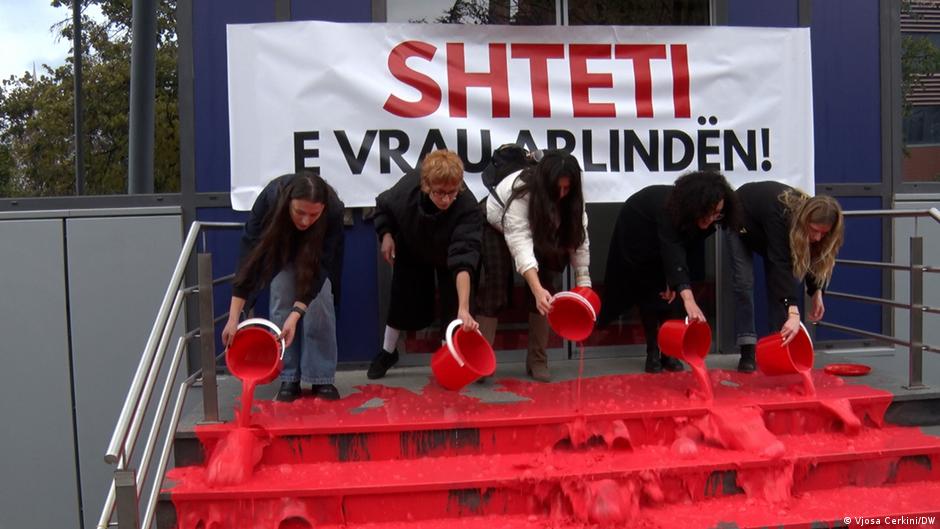
One of the first protests took place on October 26, when a group of feminists emptied buckets of red paint on steps outside the seat of Kosovo's government in the capital, Pristina.
(暂无翻译)
"The state killed Arlinda" read a banner that the activists hung at the entrance to the building.
(暂无翻译)
In the days that followed and on November 1, public anger brought thousands of people to streets across Kosovo. Many carried photographs of murdered women. One slogan appeared again and again: "The government has blood on its hands."
(暂无翻译) (暂无翻译) (暂无翻译)
The protesters are demanding that charges be brought against the police officers and prosecutors responsible for handling Zekaj's case.
(暂无翻译)
They are also calling for the resignation of Interior Minister Xhelal Svecla and Justice Minister Donika Gervalla, whom Kosovo Prime Minister Albin Kurti appointed national coordinator for protection against domestic violence in March.
(暂无翻译)
Both Svecla and Gervalla have rejected calls to step down.
(暂无翻译)
Kurti acknowledged that certain state institutions had "failed."
(暂无翻译)
In many ways, this was a murder foretold.
(暂无翻译)
In the summer, Zekaj reported her husband to the police for threatening her. A court in Peja subsequently issued a protection order, granted her temporary custody of their son and gave her the right to remain in the family home.
(暂无翻译) (暂无翻译)
The protection order allowed her husband to continue living in the same house, provided that he did not come within 2 meters (about 6.5 feet) of her. Outside the home, he was required to keep a distance of at least 20 meters.
(暂无翻译) (暂无翻译)
Zekaj had decided against moving to a shelter because she wanted to continue living in her own home with her son.
(暂无翻译)
After the protection order was issued, she repeatedly made reports to the police, including about threats from her brother-in-law Albert Sylaj.
(暂无翻译)
Three days before the killing, on October 22, Zekaj reported that members of her husband's family, including Sylaj, were in her home against her wishes. According to her account, he threatened her with the words: "Leave or I'll kill you."
(暂无翻译) (暂无翻译)
Sylaj was questioned only as a witness in the case against Zekaj's husband.
(暂无翻译)
Police arrested him near Peja on October 27. He is now under investigation for murder.
(暂无翻译) (暂无翻译)
Since 2010, 55 women in Kosovo have been killed by partners or family members — often after years of documented abuse and ignored reports to law enforcement.
(暂无翻译)
In recent years, successive Kosovo governments have adopted a number of laws and regulations aimed at better combating violence against women.
(暂无翻译)
These measures include the possibility of life sentences for perpetrators in femicide cases.
(暂无翻译)
Activists say the authorities responsible for enforcing these measures — including police, social services, prosecutors and courts — have failed to implement them consistently and in a coordinated manner.
(暂无翻译)
In an article for the newsportal Nacionale, the lawyer Njomeza Zejnullahu wrote that "after every murder, we hear the same word: failure. 'The institutions have failed.' I disagree. Failure is when something happens once, when a system that normally works breaks down at one point. When the cases keep repeating themselves, when the victims are almost always women and each of them had previously knocked on the door of an institution, it is no longer a failure. It is a collapse of the state and society in relation to women in general."
(暂无翻译) (暂无翻译) (暂无翻译) (暂无翻译)
In the aftermath of Zekaj's killing, several senior police officers from Peja and the surrounding area have been suspended. A prosecutor who had handled Zekaj's complaints has also been suspended.
(暂无翻译) (暂无翻译)
For the protesters in Kosovo, however, this is not nearly enough.
(暂无翻译)
"All those involved within the chain of responsibility must not only be removed from office but also criminally prosecuted for failing to fulfill their official duties," Liridona Sijarina, a political scientist and feminist activist with Kosovo's Kolektivi Feminist (Feminist Collective), told DW.
(暂无翻译)
"That includes not only police officers, prosecutors and judges, but also mayor of Peja Gazmend Muhaxheri and, ultimately, government ministers," she said.
(暂无翻译)
Sijarina said feminist activists were also calling on the Interior Ministry to create a dedicated unit that would treat women's safety as a matter of national security and focus specifically on preventing femicides.
(暂无翻译)
She said the government should make its draft legislation on affordable social housing a top political priority and ensure that women who have experienced domestic violence are eligible for social housing.
(暂无翻译)
"In our view, the behavior of the institutions so far has deepened women's distrust of the state and, as a result, allowed violence against them to escalate," Sijarina said. "The government now has the opportunity to show whether it truly takes women's lives seriously by clearly responding to our demands."
(暂无翻译) (暂无翻译)
This article was originally published in German.
(暂无翻译)
仅供学习使用,如有侵权请联系删除 · 查看原文