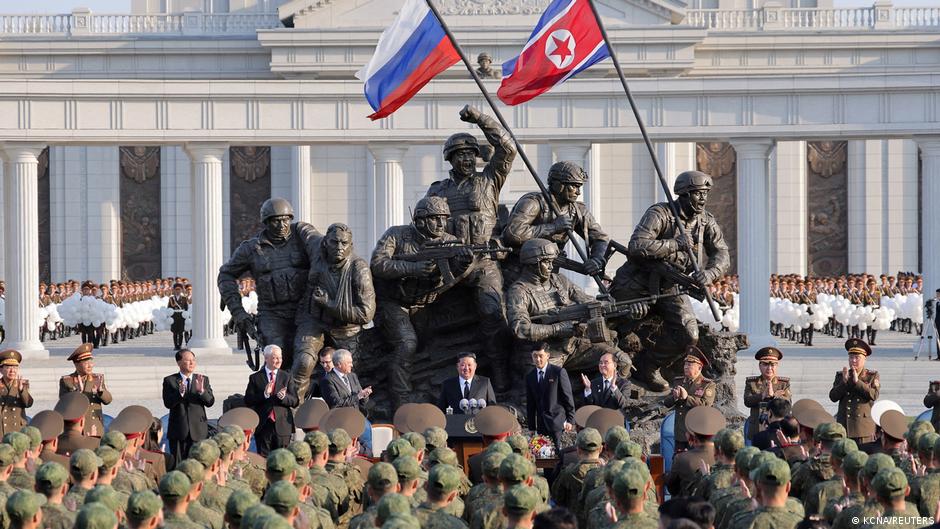
Is North Korea holding back on sending Russia more troops?
0 / 27
English
中文
A North Korean troop buildup Ukraine warned about months ago has yet to materialize, even as strategic cooperation continues. Analysts say Pyongyang is balancing its ties with Moscow and Beijing.
(暂无翻译) (暂无翻译)
Over the summer, Ukrainian President Volodymyr Zelenskyy said that he expected between 30,000 and 50,000 North Korean soldiers would be deployed to Russia as part of Pyongyang's ongoing support of Moscow's war effort.
(暂无翻译)
However, it now appears that troop buildup has yet to materialize, and it is unclear whether North Korea will continue sending large numbers of troops to Russia.
(暂无翻译)
Writing on Telegram on November 9, Andrii Kovalenko, who resigned in September as head of Ukraine's Center for Countering Disinformation, said an August intelligence assessment indicated that the Kremlin had requested more than 30,000 additional North Korean troops for an autumn offensive.
(暂无翻译)
He said a summit between North Korean leader Kim Jong Un and Russian President Vladimir Putin was expected in September, but did not happen. Kviy has claimed that North Korea previously sent thousands of troops to Russia's Kursk region in 2024, where Moscow was fighting to repel a Ukrainian incursion.
(暂无翻译) (暂无翻译)
Kovalenko believes Pyongyang turned down Moscow's request because taking part in offensive operations in Russian-occupied parts of Ukraine's Donetsk region may still be a red line for North Korea.
(暂无翻译)
However, Kovalenko added that Russia still relies on North Korean material support, particularly ammunition, while assessing that another major deployment of North Korean combat troops was unlikely this winter.
(暂无翻译)
Han Ki-bum, a former deputy director of South Korea's National Intelligence Service, told DW that the lull in fighting and the onset of winter give Pyongyang little immediate reason to send reinforcements.
(暂无翻译)
To view this video please enable JavaScript, and consider upgrading to a web browser that supports HTML5 video He added that a visit this week to Moscow by Jo Yong-won, a senior North Korean official and close aide to Kim, could shed light on any future plans.
(暂无翻译)
Han said it remained to be seen whether the visit was intended to deepen political ties between the ruling parties, building on their military cooperation, or to lay the groundwork for a visit by Kim himself.
(暂无翻译)
Ahn Chan-il, a former North Korean soldier who defected to South Korea in 1979 and now heads the World Institute for North Korea Studies in Seoul, said Moscow also had reasons to limit the deployment.
(暂无翻译)
He told DW that he expects Russia to weigh its battlefield needs against the costs of bringing in more North Korean troops.
(暂无翻译)
Unless the war expands, he said, Moscow is unlikely to request a larger contingent. Ukrainian official Kovalenko said North Korea still had a missile unit in Russia's Voronezh region and around 8,500 support personnel in rear areas, including drone operators, engineers and sappers.
(暂无翻译) (暂无翻译)
He added that Pyongyang was ramping up ammunition production and showcasing new drones and missiles.
(暂无翻译)
In a post on X on November 17, Zelenskyy said that Russia was receiving dozens of North Korean ballistic missiles each month.
(暂无翻译)
He warned that their use in Ukraine was helping Pyongyang refine its weapons and creating security risks for countries around the Korean Peninsula.
(暂无翻译)
Battle-testing weaponry is one of North Korea's primary advantages from military cooperation with Russia To view this video please enable JavaScript, and consider upgrading to a web browser that supports HTML5 video Kovalenko said Pyongyang appeared to have adopted what he called a "containment strategy," limiting its military commitment to Russia's war while maintaining ties with both Moscow and Beijing. In his assessment, this approach allows Pyongyang to retain the benefits of its alliance with Russia while reducing its exposure to the outcome of the war.
(暂无翻译) (暂无翻译)
Analyst Ahn said he expects Pyongyang's military cooperation with Moscow to continue because Russian assistance is crucial to North Korea's efforts to develop drone technology and strengthen its navy.
(暂无翻译)
Nevertheless, the extent of this cooperation may be more limited in the future, and Pyongyang is also able to turn to China as a hedge.
(暂无翻译)
Ahn said that if Russia limits the deployment of North Korean troops, Pyongyang's foreign currency earnings from those deployments would have less room to grow, giving it another reason to seek more support from Beijing Jeong Joon Hee, a former South Korean Unification Ministry spokesperson, told DW that recent moves towards building better ties with Beijing may also reflect Pyongyang's dissatisfaction with what Moscow has offered in return for North Korea's help.
(暂无翻译)
By strengthening its relationship with China while keeping ties with Russia steady, he said, Pyongyang could also be trying to persuade Moscow to give it more.
(暂无翻译)
Kim Hyung Suk, a former South Korean vice minister of unification, told DW that North Korea needs China's economic, political and diplomatic backing alongside the support it receives from Russia.
(暂无翻译)
He expects Pyongyang to keep pursuing China's support regardless of how it manages its role in the war.
(暂无翻译)
仅供学习使用,如有侵权请联系删除 · 查看原文