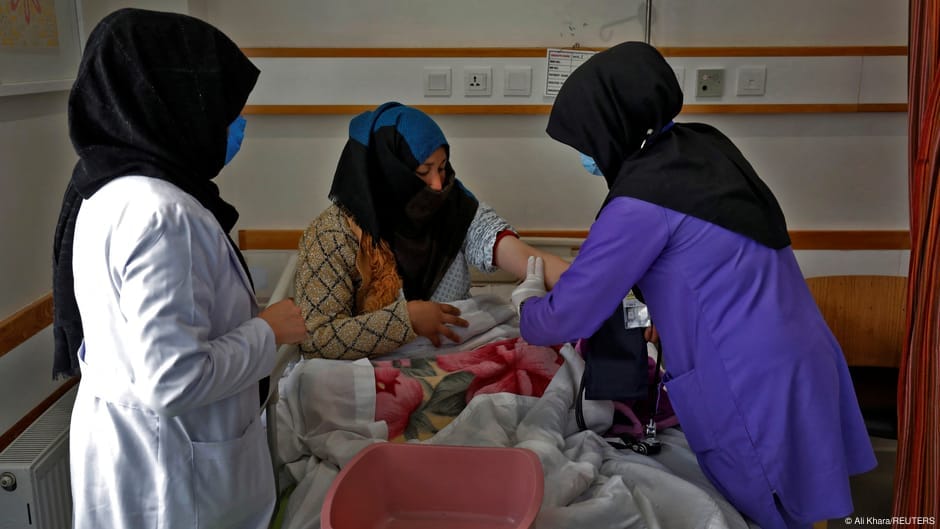
In Afghanistan, no female doctor often means no treatment for women
0 / 38
English
中文
Millions of women in Afghanistan, particularly pregnant women, are suffering under Taliban restrictions and are increasingly losing access to life-saving medical care.
(暂无翻译)
In many parts of Taliban-ruled Afghanistan, male doctors are no longer allowed to treat women. The consequences have been highlighted in a recent United Nations report, which offers disturbing insight into the harsh reality many women face.
(暂无翻译) (暂无翻译)
In one case, a woman from Kunar province described how she suffered several miscarriages without being able to access medical care.
(暂无翻译)
Her case highlights the increasing number of pregnant women who urgently need medical assistance and are unable to receive it because of restrictions imposed by the Taliban.
(暂无翻译)
And overall, women in Afghanistan are increasingly losing access to essential healthcare. This is due both to the Taliban's restrictions and to cuts in international aid funding.
(暂无翻译) (暂无翻译)
"If a pregnant woman dies because male doctors are not allowed to treat her, her husband can marry another, younger woman. That is how the Taliban think," said 28-year-old Tamana Zaryab Paryani.
(暂无翻译) (暂无翻译)
Paryani is an Afghan women's rights activist and one of the best-known voices of resistance against the Taliban.
(暂无翻译)
To view this video please enable JavaScript, and consider upgrading to a web browser that supports HTML5 video A trained lawyer, she worked as a newspaper journalist before the Taliban returned to power.
(暂无翻译)
Following their takeover in August 2021, she took part in protests against restrictions on the rights of women and girls. In January 2022, she was detained by the Taliban in Kabul alongside her sisters. After her release, she managed to reach Europe. Since then, she has continued to advocate internationally for the rights of Afghan women.
(暂无翻译) (暂无翻译) (暂无翻译) (暂无翻译)
At the end of October, she addressed the UN Security Council, describing the repression of women in Afghanistan and urging the international community not to normalise their systematic disenfranchisement. "This is gender apartheid.
(暂无翻译) (暂无翻译)
We expect the international community to recognise it and stand with the women of Afghanistan," Paryani told DW. Since returning to power in 2021, the Taliban have issued more than 100 decrees severely restricting the lives of women and girls.
(暂无翻译) (暂无翻译)
Girls are barred from secondary education, while women are denied access to universities. Women's opportunities to work outside the home are also severely restricted. To view this video please enable JavaScript, and consider upgrading to a web browser that supports HTML5 video The UN Assistance Mission in Afghanistan (UNAMA), which monitors and regularly documents the human rights situation in the country, reported in September 2025 that inspectors from the Taliban's Ministry for the Promotion of Virtue and Prevention of Vice were further restricting women's access to healthcare through the enforcement of regulations and decrees.
(暂无翻译) (暂无翻译) (暂无翻译)
According to the UN, around 2.6 million girls are excluded from secondary education.
(暂无翻译)
This is likely to lead to more girls being married off at an early age and to an increase in maternal mortality, UN Women warns.
(暂无翻译)
Afghanistan has a population of around 45 million. With a median age of approximately 17, it has one of the youngest populations in the world.
(暂无翻译) (暂无翻译)
Around 42% of its population is under the age of 15. "What is happening in Afghanistan goes beyond gender-based persecution, as already defined under the Rome Statute of the International Criminal Court," Haroon Mutasem, professor of International Criminal Law at the American University of Afghanistan and research fellow at Berlin's Humboldt University, told DW. The Afghan legal scholar examines how the systematic oppression of women in Afghanistan can be classified and prosecuted under international law.
(暂无翻译) (暂无翻译) (暂无翻译)
"This is not just about individual acts of persecution, but about an institutionalised system of oppression and domination of one gender group by another.
(暂无翻译)
They have established a system that considers women as secondary and defines a life for them as raising kids, working at home, and also actually satisfying the sexual desires of their men."
(暂无翻译)
Mutasem argues that failure to respond to the systematic oppression of Afghan women could undermine the universal validity of human and women's rights. He warns that other authoritarian regimes and extremist movements could adopt similar practices.
(暂无翻译) (暂无翻译)
According to UN estimates, in 2027 more than 4 million children under the age of five, as well as around 1.27 million pregnant and breastfeeding women, will require treatment for acute malnutrition. Susan Ferguson, the UN's Special Representative in Afghanistan, described the situation in her latest report as "the world's worst women's rights crisis."
(暂无翻译) (暂无翻译)
Afghan women, she said, are now "fighting for their very survival."
(暂无翻译)
Cuts in aid funding have forced humanitarian organisations to make "impossible decisions about which women and girls can receive support and which have to be turned away," Ferguson said. To view this video please enable JavaScript, and consider upgrading to a web browser that supports HTML5 video This article was originally written in German.
(暂无翻译) (暂无翻译)
仅供学习使用,如有侵权请联系删除 · 查看原文