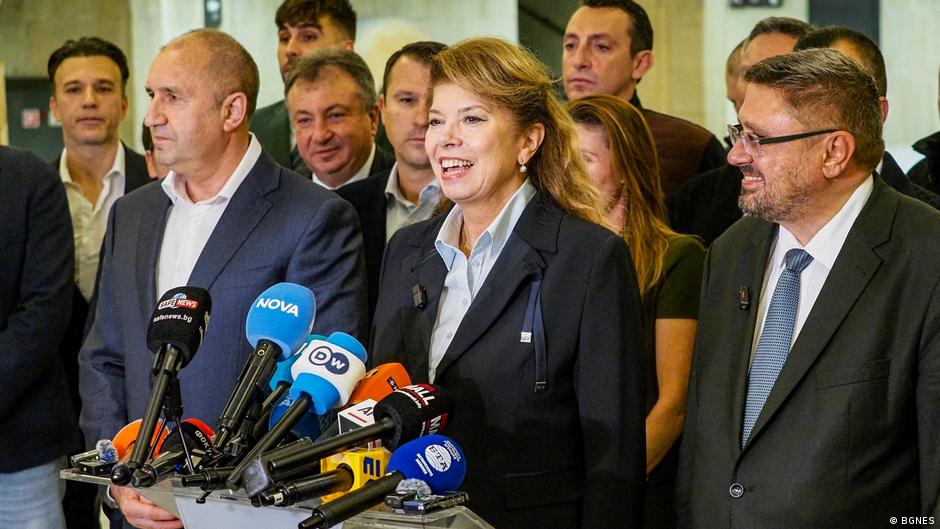
How Iliana Yotova won the presidential election in Bulgaria
0 / 52
English
中文
Iliana Yotova won the presidential election in Bulgaria, promising to be a "president of peace." But the campaign showed how divided Bulgarians are about the war in Ukraine and drone attacks in the Black Sea.
(暂无翻译) (暂无翻译)
"We are choosing between war and peace," Bulgarian Prime Minister Rumen Radev told voters ahead of Sunday's presidential election runoff between incumbent President Iliana Yotova, who opposes military aid to Ukraine and favors dialogue with Russia, and former caretaker Prime Minister Andrey Gyurov, who is regarded as staunchly pro-European and pro-Ukrainian.
(暂无翻译)
With these words, it was clear that Sunday's runoff had turned into a kind of referendum on the country's foreign policy and stance on the war in Ukraine.
(暂无翻译)
Now that the official results are in and it is clear that Iliana Yotova won the election decisively by 57.6% to Gyurov's 39.5%, Radev claims that Bulgarians have chosen peace.
(暂无翻译)
When the presidential election campaign began in Bulgaria on September 25, there did not seem to be any doubt about the outcome: Iliana Yotova was well ahead in the polls on 44.5%. Gyurov, her main rival, trailed far behind on 26.1%.
(暂无翻译) (暂无翻译)
Yotova was backed by both the prime minister and his ruling Progressive Bulgaria party, which won an absolute majority in the parliamentary election on April 19.
(暂无翻译)
But the first round turned out to be much tighter than anticipated.
(暂无翻译)
While Yotova got 34.8% of the vote in the first round, Gyurov was close behind on 31.95%, which meant that a runoff between the two was necessary.
(暂无翻译)
While Yotova won the runoff convincingly, both the campaign and the outcome showed that the Bulgarian electorate is divided.
(暂无翻译)
This division is both generational and geographical, explains Dimitar Ganev, sociologist and political scientist at the Trend market and electoral research agency.
(暂无翻译)
"Younger voters — those aged between 18 and 40 — favor Gyurov. Those over 40 tend to prefer Yotova," Ganev told DW. "It also appears that Gyurov dominates in the capital, Sofia. In smaller regional cities, other towns and villages, Yotova dominates decisively," he said.
(暂无翻译) (暂无翻译) (暂无翻译) (暂无翻译)
This divide was also evident during the campaign.
(暂无翻译)
While Andrey Gyurov relied mainly on social media for his campaign, Yotova chose to speak mostly to supporters of Progressive Bulgaria in closed venues.
(暂无翻译)
At such events, the war in Ukraine was always high on the agenda.
(暂无翻译)
"As long as I am president, and if you place your trust in me, not a single Bulgarian soldier will go to Ukraine," Yotova declared at an election rally on October 6 — even though according to the Bulgarian Constitution, only parliament (not the president) has the authority to send troops abroad or declare war.
(暂无翻译)
Throughout the campaign, she referred to her opponents as "warmongers" and described herself as the "president of peace."
(暂无翻译)
"We won because we talked to people about income and about peace," Yotova said after the election.
(暂无翻译)
In this, she is similar to Prime Minister Rumen Radev.
(暂无翻译)
When it comes to Ukraine, Radev regularly speaks of the need for peace and avoids calling Russia an "aggressor." Both Radev and Yotova oppose military aid to Ukraine and criticize European leaders for not making sufficient efforts to engage with Russian President Vladimir Putin.
(暂无翻译) (暂无翻译)
Gyurov, on the other hand, has sharply criticized Russian aggression in Ukraine.
(暂无翻译)
Appointed caretaker prime minister by Yotova in February, Gyurov in March signed a security cooperation agreement with Ukraine, provoking the disapproval of both Yotova and Radev.
(暂无翻译)
In the weeks leading up to the election, several ships in the Black Sea were hit by drones off the Bulgarian coast.
(暂无翻译)
The European Council criticized Russia for the escalation, and the European Parliament called on the EU and its member states "to consider deploying an EU naval operation" there.
(暂无翻译)
Prime Minister Radev, however, was not as equivocal, going no further than summoning the Russian ambassador and stating that "logic suggests that the outcome" of the attacks in the Black Sea "is to the advantage of the Russian Federation."
(暂无翻译)
Just days before the runoff, he noted that "two ships were struck and sunk in Romanian territorial waters" after Romania had held Russia responsible for the attacks in the Black Sea.
(暂无翻译)
"Many people think that once the aggressor is identified, the attacks will stop," he said, downplaying the Kremlin's responsibility. His remarks drew criticism from politicians and the media in Romania.
(暂无翻译) (暂无翻译)
Yotova also did not name Russia as the perpetrator, instead saying during her campaign that she did not want to see "foreign flags in Bulgaria" — a clear reference to the Ukrainian flag, which has been displayed outside several institutions in Bulgaria as a sign of solidarity with the war-torn country.
(暂无翻译)
Most opposition parties, including the right-wing conservative GERB led by former long-serving Prime Minister Boyko Borisov, refused to field a candidate for the presidency, which is one reason why turnout on Sunday was less than 30%.
(暂无翻译)
In the first round, the pro-Russian candidate Kostadin Kostadinov from the nationalist Vazrazhdane (Revival) party came third with 12.5% of the vote. According to Dimitar Ganev, around 70% of Vazrazhdane voters backed Yotova in the runoff.
(暂无翻译) (暂无翻译)
To secure their support, Yotova targeted pro-Russian voters.
(暂无翻译)
To view this video please enable JavaScript, and consider upgrading to a web browser that supports HTML5 video "Russia is by no means an enemy of Bulgaria," she said in a podcast interview just two days before the runoff, adding "Russia is part of our history, and I very much hope that it will be a key factor in the future security architecture across Europe, including for us."
(暂无翻译)
In the days leading up to the vote, some of her supporters began claiming that the opposition was preparing a "Maidan," a reference to the Ukrainian revolution of 2014 that culminated in the ousting of President Viktor Yanukkovych, who had close ties to Moscow.
(暂无翻译)
"All of Gyurov's lackeys are speaking openly about inevitable protests.
(暂无翻译)
They're using prime time to stir up a Maidan. Every single one of them," Sonya Momchilova, who was appointed to the media regulator by Radev, wrote on Facebook on Sunday. Similar claims were made by both former Hungarian Prime Minister Viktor Orban and former Serbian President Aleksandar Vucic ahead of this year's elections in their countries.
(暂无翻译) (暂无翻译) (暂无翻译)
"This claim that Ms.
(暂无翻译)
Yotova will be a president of peace is directly linked to the incitement of a fear of war," said former Defense Minister Todor Tagarev, who was part of the committee that nominated Andrey Gyurov for president. "Bulgaria will be in a much worse position within Europe and NATO under her leadership," he said during a TV interview. Dimitar Ganev, on the other hand, sees no threat to Bulgaria's commitment to the EU and NATO.
(暂无翻译) (暂无翻译) (暂无翻译)
"Over two-thirds of Bulgarians do not question the country's geopolitical orientation, and around two-thirds have a positive attitude towards the EU," he told DW. But the positions of Radev and Yotova, which many view as ambivalent, mobilized both the pro-European camp and Eurosceptic voters, who, according to Ganev, make up around a third of the country's population.
(暂无翻译) (暂无翻译)
According to Prime Minister Rumen Radev and President Iliana Yotova, the Bulgarian people chose peace in the presidential election.
(暂无翻译)
Nevertheless, the war continues.
(暂无翻译)
仅供学习使用,如有侵权请联系删除 · 查看原文