Germany's Early Start Pension: Can child investment accounts help?
0 / 45
English
中文
Germany plans to pay €10 a month into investment accounts for children to encourage long-term retirement saving. Economists say the measure may help build wealth but won't solve the country's pension funding challenge.
(暂无翻译) (暂无翻译)
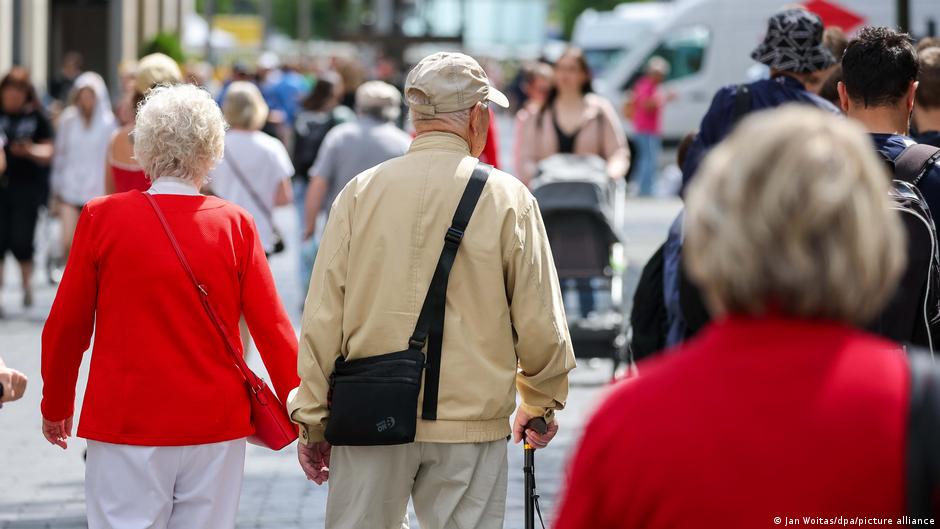
Germany's pension system is under growing strain as demographic change leaves a shrinking workforce funding the pensions of an increasing number of retirees.
(暂无翻译)
In the 1960s, for instance, six workers contributed to the pay-as-you-go public retirement system for each pensioner. Today, that figure has fallen to just two contributors per retiree.
(暂无翻译) (暂无翻译)
According to the Federal Statistical Office, Germany's fertility rate is currently 1.32 children per woman,and has remained below the 2.1 needed to maintain a stable population since the 1970s.
(暂无翻译)
As a large cohort of baby boomers reaches retirement age, fewer young people are entering the workforce. Germany's working-age population is shrinking by around 1% each year due to demographic change alone, according to the German bank LBBW.
(暂无翻译) (暂无翻译)
To keep up, nearly a quarter of the federal budget, over €123 billion ($135 billion), is transferred to the statutory pension system each year to help finance pension payments.
(暂无翻译)
Now to help ease the pressure on the pension system, Chancellor Friedrich Merz's government plans to implement a raft of reforms, including a supplementary, capital-funded savings scheme known as the Frühstartrente, or Early Start Pension.
(暂无翻译)
Under the plan, the state would pay €10 per month into an investment account for every child and teenager aged six to 18.
(暂无翻译)
Beneficiaries would not be able to access the money until they reach retirement age, though current plans would allow the funds to be transferred into private retirement accounts. Investment returns would be tax-free during the accumulation phase and taxed only when funds are withdrawn.
(暂无翻译) (暂无翻译)
Assuming an average annual return of 7%, the €1,440 contributed by the government over 12 years would grow to around €53,000 by retirement, according to government projections.
(暂无翻译)
Parents and relatives would be able to make additional contributions. If they invest an extra €50 per month, the account could grow to as much as €300,000 by retirement.
(暂无翻译) (暂无翻译)
Starting to save early makes sense because of the power of compound interest, Axel Börsch-Supan, a professor of economics at the Technical University of Munich, told DW.
(暂无翻译)
"But it will not solve Germany's pension problems, which stem from the pay-as-you-go system and costly policies such as the pension level guarantee and retirement at 63," he added, referring to a provision that allows workers with at least 45 years of pension contributions to retire at age 63 with a full pension.
(暂无翻译)
To view this video please enable JavaScript, and consider upgrading to a web browser that supports HTML5 video Börsch-Supan argues that government subsidies under the program are likely to benefit higher-income families more than lower-income households.
(暂无翻译)
"That's a waste of taxpayer money, because higher-income individuals are already well-positioned to provide for their own retirement and that of their children," he said.
(暂无翻译)
The Ifo Institute, one of Germany's leading economic think tanks, shares a similar assessment.
(暂无翻译)
It argues that the scheme effectively means "the government hands out money indiscriminately, only to reclaim it through taxes from the same citizens."
(暂无翻译)
The government, however, argues that the plan gives every child a head start in the capital markets regardless of their family's financial circumstances and helps them build retirement savings and long-term wealth.
(暂无翻译)
Similar capital market-based savings and investment accounts for children exist in several countries, including the United Kingdom, Israel, Canada and Singapore.
(暂无翻译)
Many of these programs include government contributions, matching payments or tax incentives designed to encourage long-term saving and asset accumulation from an early age.
(暂无翻译)
But Germany's plan differs slightly as it links state-funded childhood investment accounts directly to retirement provision.
(暂无翻译)
The government also hopes the program will boost financial literacy among children and young adults by familiarizing them with investing, saving and capital markets.
(暂无翻译)
To view this video please enable JavaScript, and consider upgrading to a web browser that supports HTML5 video Johannes Geyer, deputy head of the department of public economics at the German Institute for Economic Research (DIW Berlin), says there is little evidence the Early Start Pension will fundamentally change how people engage with financial markets.
(暂无翻译)
"The idea is that people will develop a connection to the capital markets through their experiences with their investment portfolios," he told DW.
(暂无翻译)
"But this is not very convincing.
(暂无翻译)
We neither know what experiences the future will bring nor what conclusions people will draw from them." Geyer stresses that the program's impact will not be visible for decades because participants cannot access the funds until retirement. "If we start now with the 2020 and 2021 cohorts, we're talking about the 2080s.
(暂无翻译) (暂无翻译) (暂无翻译)
That's a bit too far in the future to be able to draw meaningful conclusions."
(暂无翻译)
In the meantime, he says, the scheme's most immediate effect may be to strengthen ties between families and financial institutions, particularly if account holders make additional contributions. Opposition parties, including the Greens and the Left Party, have criticized the plan, arguing it would reinforce social disparities and boost inequality since better-off parents could pay more into accounts.
(暂无翻译) (暂无翻译)
Yet Geyer says the measure won't increase inequality per se.
(暂无翻译)
"Sure, wealthy families are more likely to top up their contributions more substantially.
(暂无翻译)
But they probably would have done that anyway," he underscored. "A more interesting question is whether the measure can also encourage people with limited financial means to invest in stocks," he said. Geyer points out that Germany cannot entirely escape the costs of demographic decline and an aging society.
(暂无翻译) (暂无翻译) (暂无翻译)
To address the challenge, he calls for a moderate increase in pension contributions, a broader contributor base that includes groups such as the self-employed, and policies aimed at attracting more qualified workers to the labor market.
(暂无翻译)
Börsch-Supan, who specializes in the economics of aging, says the government's primary goal should be to stabilize the pay-as-you-go statutory pension system.
(暂无翻译)
"A transition to a fully funded pension system would actually be desirable, but it would initially place a heavy double burden on the younger generation, because they would have to save for themselves while also paying contributions for their parents," he explained.
(暂无翻译)
The expert also suggests other measures like restoring the sustainability factor, which is designed to link annual pension hikes to demographic shifts, and linking the retirement age to life expectancy.
(暂无翻译)
仅供学习使用,如有侵权请联系删除 · 查看原文