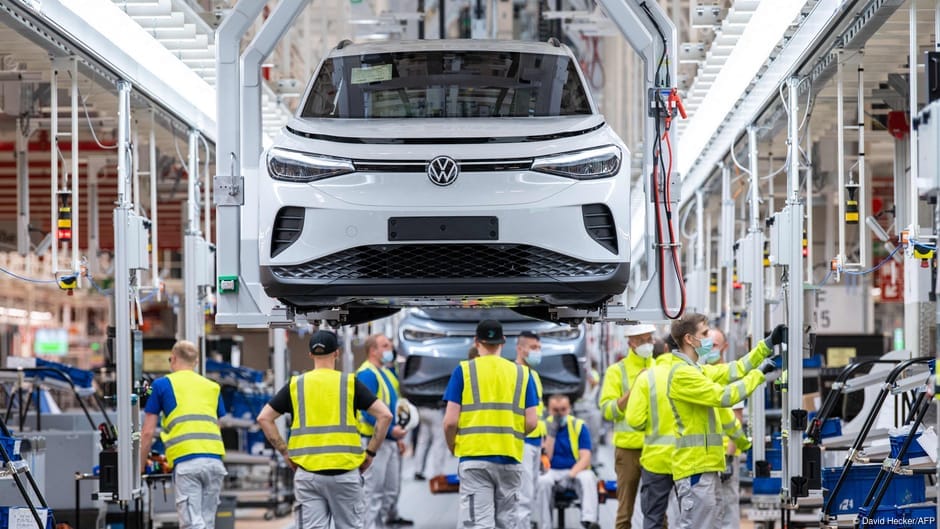
German auto workers on back foot as costs, competition bite
0 / 52
English
中文
German auto workers profited during the industry's boom years, but are now increasingly being asked to trade past gains for future job security.
(暂无翻译)
For decades, German auto bosses and labor representatives touted their ability to work through their disagreements in a uniquely cooperative process. Those days appear to be gone.
(暂无翻译) (暂无翻译)
A series of crises across the industry and abrupt moves by management to slash costs are testing the limits of the German power-sharing agreement.
(暂无翻译)
As negotiations between union representatives and Germany's largest carmaker, Volkswagen, began on Tuesday, the balance of power appeared increasingly one-sided.
(暂无翻译)
Volkswagen wants to freeze wages for the next two years while cutting several allowances and bonuses.
(暂无翻译)
Alongside Mercedes, it's demanding longer hours under the same pay, with both companies threatening to withhold investment from German factories.
(暂无翻译)
Unions have responded with warning strikes and the threat of larger walkouts. Yet workers are aware of the grim outlook, with Germany's auto industry losing more than 123,000 jobs between 2019 and 2025, according to the Ifo Institute.
(暂无翻译) (暂无翻译)
"I think that the labor representatives are in a very difficult situation," said Thomas Haipeter, a labor researcher at the University of Duisburg-Essen. "On the one hand, they have to make concessions in order to safeguard jobs. And despite these massive employment reductions to safeguard the rest of the jobs and locations, what is missing for them is a kind of more offensive strategy."
(暂无翻译) (暂无翻译) (暂无翻译)
To view this video please enable JavaScript, and consider upgrading to a web browser that supports HTML5 video Labor's outsized role in German auto companies goes back decades and includes a 1945 deal at Volkswagen promising a hot shower a day.
(暂无翻译)
That year marks the start of "co-determination" at the company, in which workers are represented internally by employee-led workers' councils, as well as by outside labor unions.
(暂无翻译)
Berlin then anchored labor's strong say in Volkswagen in 1960, before the firm issued public shares, ensuring government officials retained extra votes in the supervisory board.
(暂无翻译)
Those seats, belonging to the Lower Saxony government, tend to be sympathetic to workers. Workers' councils, meanwhile, became a fixture across the German auto industry, with representation extending across multiple production sites within the same companies.
(暂无翻译) (暂无翻译)
Pay and benefits for auto workers have risen over the years.
(暂无翻译)
During the last German industry boom, between 2011 and 2019, pay for auto workers clearly outpaced the average German wage. In early 2025, auto workers were earning nearly a third more per hour than the typical German worker, when bonuses and allowances are factored in, according to Germany's Federal Statistical Office (Destatis).
(暂无翻译) (暂无翻译)
That same year, Volkswagen CEO Oliver Blume praised cooperation with the unions as one of the company's "great strengths" during the 80th anniversary of the 1945 agreement.
(暂无翻译)
Cracks were long in the making, according to case studies by Haipeter and others.
(暂无翻译)
Labor was increasingly forced to protect plants and jobs as companies chased cheaper workers abroad. Workers' councils turned their attention to saving their own production lines.
(暂无翻译) (暂无翻译)
They focused on business strategy and even hired business consultants in an effort to sway strategy. When combustion engines dominated, autoworkers could argue German production was the most technologically advanced, according to Haipeter.
(暂无翻译) (暂无翻译)
That changed with the shift to electric vehicles. "This line of compromise is canceled now by management," he said.
(暂无翻译) (暂无翻译)
"They say it doesn't matter for us where we produce. We have to produce at the locations or in countries which are best-cost countries and not in countries which have higher wages." Slow sales of electric autos and competition from Chinese manufacturers have, meanwhile, exposed the cost difference.
(暂无翻译) (暂无翻译) (暂无翻译)
In 2024, Volkswagen abruptly canceled a series of labor agreements and threatened factory closures.
(暂无翻译)
After tough negotiations, labor agreed to significant cuts — €1.5 billion yearly in abandoned wage hikes and the elimination of 50,000 positions through attrition — in exchange for job security for current employees through 2030. Management returned this summer with a restructuring plan that included the closures of four German plants.
(暂无翻译) (暂无翻译)
It delayed that decision following negotiations, but slated another 50,000 positions for attrition. Volkswagen declined to comment for this article.
(暂无翻译) (暂无翻译)
To view this video please enable JavaScript, and consider upgrading to a web browser that supports HTML5 video The most sensitive issue for unions may be the demand that employees work more for the same amount of pay, or even receive less for less work.
(暂无翻译)
The union IG Metall won the concession for a 35-hour workweek in 1984 after seven weeks of strikes.
(暂无翻译)
It's now standard in every labor contract in the auto industry, although it's not uncommon for worksites to deviate from the employee agreement, according to Haipeter.
(暂无翻译)
Mercedes has called for employees to agree to an exception across the company. The company acknowledged that the 35-hour workweek was "hard-won" and "means a great deal" to its workers.
(暂无翻译) (暂无翻译)
"However, the conditions under which it was agreed upon no longer exist today," it said in a statement to DW. Volkswagen, meanwhile, is demanding greater "flexibility" as the negotiations get underway. "They call it flexibility in both directions," Thorsten Gröger, head of negotiations for the union, said last week.
(暂无翻译) (暂无翻译) (暂无翻译)
"In the end, Volkswagen wants its employees to perform unpaid work."
(暂无翻译)
The 35-hour workweek is too sacred for unions to give in, said Ferdinand Dudenhöffer, a longtime analyst of the German car industry. "The unions are in a difficult position," he noted.
(暂无翻译) (暂无翻译)
"They battled for a 35-hour workweek, and that's an incredible privilege that comes with a lot of pride.
(暂无翻译)
The union knows that as soon as one factory, one production hall, gives up the 35-hour workweek, then they will have a conflagration." Dudenhöffer sees parallels in another crisis from Volkswagen's history. After a downturn in the early 1990s, the then-head of the German state of Lower Saxony, Gerhard Schröder, pushed for an agreement for workers to work less in exchange for retaining their jobs.
(暂无翻译) (暂无翻译) (暂无翻译)
"We need a mediator along these lines," Dudenhöffer said.
(暂无翻译)
仅供学习使用,如有侵权请联系删除 · 查看原文