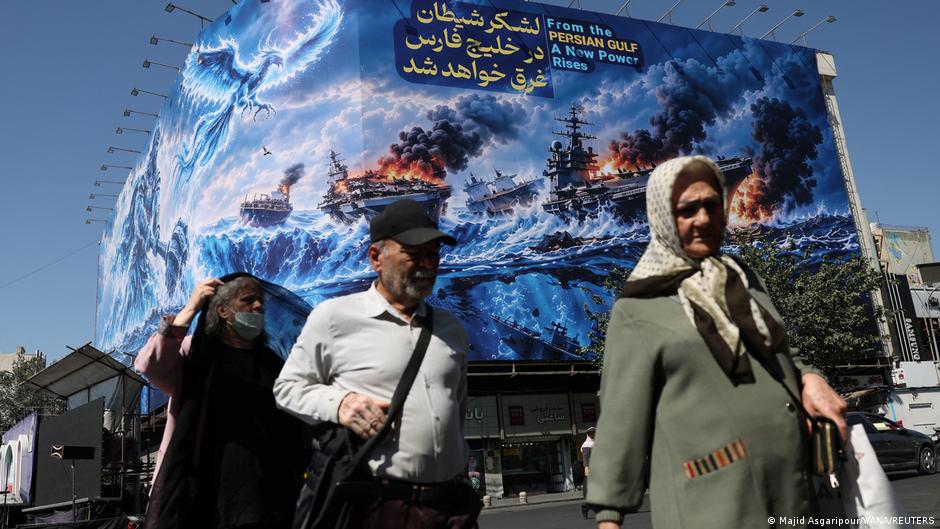
For people in Iran, a constant threat of war and dearth of information
0 / 41
English
中文
Most people in Iran have little idea of the course of the US-led war and peace talks on the global stage. With few sources of information, the population must navigate conflicting rumors and fears of a nuclear attack.
(暂无翻译) (暂无翻译)
"There is a constant sense of fear in the air," a 37-year-old mother in Tehran told DW. "Every time I hear a loud noise, I flinch. Even when a door slams, I jump — thinking that bombs are falling."
(暂无翻译) (暂无翻译) (暂无翻译)
Now, unlike in the opening months of the war, her children are back at school.
(暂无翻译)
"I don't work, but keeping the children at home out of fear is not a solution," she said. "They would go stir-crazy in our small apartment."
(暂无翻译) (暂无翻译)
Schools remain open across Iran despite the military standoff with the US and Israel. However, some parents whose children attend private schools have received messages from those schools explaining what to do in the event of a renewed war or other emergency.
(暂无翻译) (暂无翻译)
Numerous parents have shared such messages on social media.
(暂无翻译)
Irans Education Ministry has tried to reassure the public.
(暂无翻译)
To view this video please enable JavaScript, and consider upgrading to a web browser that supports HTML5 video "People should not pay attention to rumors spread with the aim of sowing fear and forcing schools to close," Ali Farhadi, a ministry spokesperson, said in a recent media interview.
(暂无翻译)
Farhadi said the ministry would decide whether the schools stay open or close, and would do so in coordination with the security authorities.
(暂无翻译)
Should the security outlook change, the situation will be reassessed accordingly, the official said. Parallel to Farhadi's appeal to disregard rumors aimed at raising fear, state media themselves are discussing scenarios of a possible nuclear attack.
(暂无翻译) (暂无翻译)
On November 2, Iranian state television broadcast an advisory on protective measures in case of a nuclear strike.
(暂无翻译)
People were advised to remain in a shelter for at least 24 hours in the event of such an emergency. Many in Iran fear that the United States is preparing to use nuclear weapons against the "Pickaxe Mountain" underground bunker about 220 kilometers (130 miles) south of Tehran.
(暂无翻译) (暂无翻译)
US President Donald Trump has hinted at attacking the location, which is close to Iran's Natanz nuclear facility, but made no explicit mention of using nuclear weapons. Iran's government denies that any work related to its nuclear program is being carried out at the mountain bunker.
(暂无翻译) (暂无翻译)
The fighting between the United States and Iran has mostly petered out in recent months as the Trump administration focused on the midterm election.
(暂无翻译)
But two days after the election, on November 5, the US news outlet Axios reported that the US military was making final preparations for a possible resumption of large-scale strikes against Iran. At the same time, there are also hopes that a Democrat-controlled Congress would force Trump to scale down his military ambitions.
(暂无翻译) (暂无翻译)
"It is still difficult to make any concrete assessment of the implications of the US midterm election results for the war with Iran," Hamidreza Azizi, the International Crisis Group's consulting senior Iran analyst, wrote in response to questions from DW.
(暂无翻译)
Iran's government sees the election results as a victory, Azizi wrote.
(暂无翻译)
The regime's resistance to the Trump administration has contributed to the Republican Party's loss in the US midterms, and some in Tehran are already seeking to frame the result as a sort of revenge for the US-Israeli assassination of senior Iranian leaders in the opening stages of the war. Against this backdrop, Iran is likely to take an even harder line on its core demands.
(暂无翻译) (暂无翻译)
Trump has at least two months before the new Congress takes office, Azizi wrote.
(暂无翻译)
He could decide to resume strikes on Iran in an attempt to offset a domestic political setback by targeting a foreign policy victory. To view this video please enable JavaScript, and consider upgrading to a web browser that supports HTML5 video Qatari mediators are trying to persuade the Iranian and US governments to agree on a draft peace deal.
(暂无翻译) (暂无翻译)
The aim is to prevent another round of escalation and pave the way for the resumption of direct talks in the coming days.
(暂无翻译)
But even well-connected journalists in Iran have little information on the substance of the talks, which are closed to the public. In a post on X on October 31, the Iranian journalist Hadi Mohammadi wrote: "Domestic media outlets are completely in the dark about negotiations that directly affect people's everyday lives.
(暂无翻译) (暂无翻译)
They have to wait for reports from Axios, Al Arabiya, Al Jazeera and other international media outlets.
(暂无翻译)
In such an environment, developing our own narratives and doing journalism becomes pointless." As the fog of war persists, many in Iran no longer have the energy to keep up with the media reporting. A 72-year-old retired woman from western Iran told DW she now deliberately avoids the news.
(暂无翻译) (暂无翻译) (暂无翻译)
"I hardly have the strength to think about it anymore," she said. "I'm just glad that my three children have emigrated."
(暂无翻译) (暂无翻译)
To view this video please enable JavaScript, and consider upgrading to a web browser that supports HTML5 video This article was originally published in German.
(暂无翻译)
仅供学习使用,如有侵权请联系删除 · 查看原文