EPA says initial tests show no toxic lead contamination in Iowa following detonation
0 / 25
English
中文
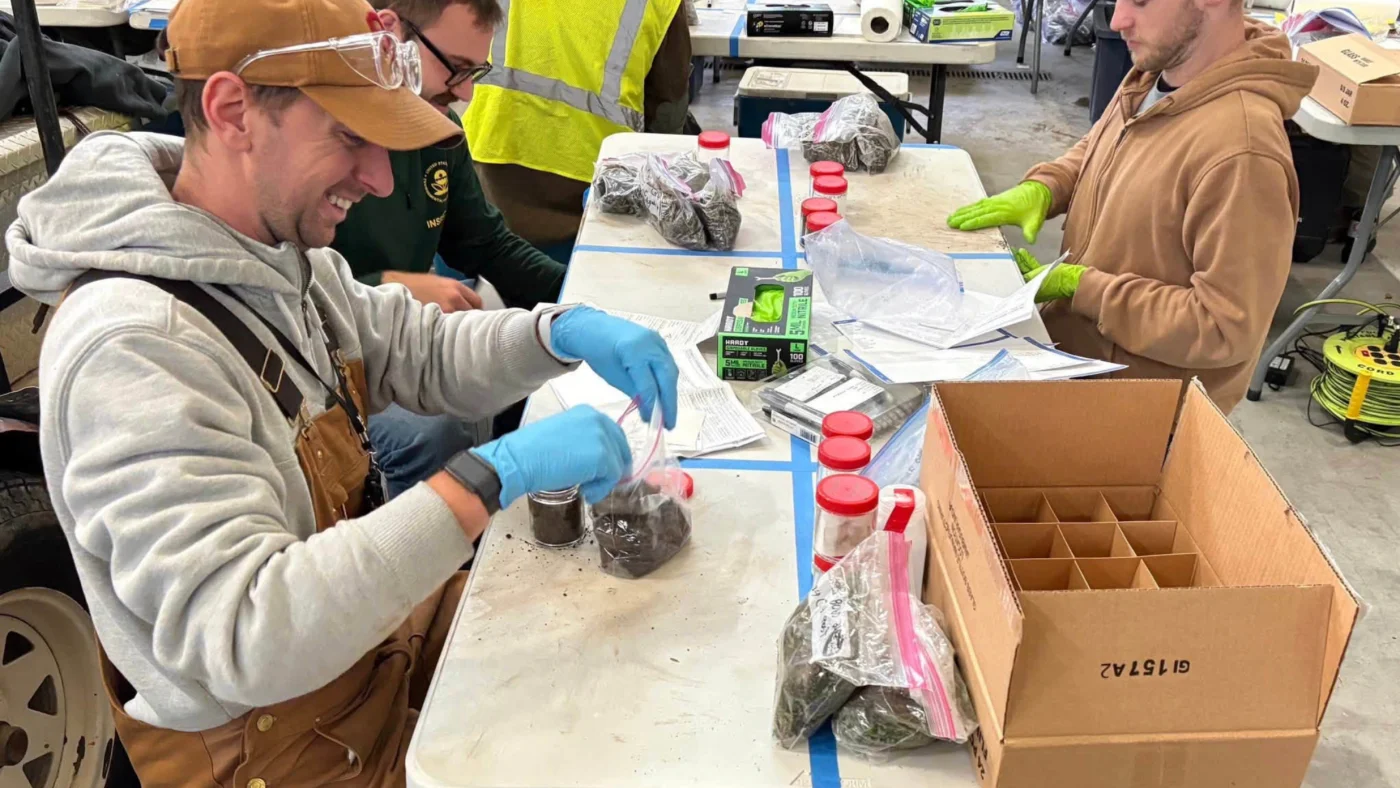
This image provided by the U.S. Environmental Protection Agency (EPA) shows workers in Middletown, Iowa, preparing soil samples to be shipped to laboratories for testing on Thursday, Nov. 26, 2026. U.S. Environmental Protection Ag/U.S. Environmental Protection Ag hide caption Initial lab results from the controlled detonation of roughly five tons of unstable lead azide at a U.S.
(暂无翻译) (暂无翻译) (暂无翻译) (暂无翻译)
Army ammunition plant in southeastern Iowa showed no elevation of lead in water sources in the surrounding environment, the U.S. Environmental Protection Agency said Saturday. "We will continue to provide updates in the coming days as new lab results for over 3,200 air, soil, dust and water samples (collected pre and post detonation) rapidly return and get validated," the agency wrote in a post on X.
(暂无翻译) (暂无翻译) (暂无翻译)
The EPA says a team of 300 personnel and contractors spent the days immediately following Wednesday's blast collecting samples, in addition to monitoring for airborne lead for 30 consecutive hours.
(暂无翻译)
Lead is a toxic heavy metal that does not degrade or break down over time.
(暂无翻译)
It's especially dangerous to children and pregnant people, and experts say there is no safe level of exposure. Military explosives experts detonated 68 drums of aging lead azide at the Iowa Army Ammunition Plant in Middletown after it was found to be at risk of spontaneous explosion.
(暂无翻译) (暂无翻译)
Residents within five miles of the plant were ordered to evacuate, and many others told to stay inside, amid fears of a toxic plume of the chemicals. In the hours immediately after the explosion, U.S.
(暂无翻译) (暂无翻译)
Army officials called the detonation a success, saying that the mitigation measures put in place – including layers of contaminant and downward-facing explosives meant to drive the blast into the ground – had "exceeded expectations." Still, many residents and some elected officials have criticized the military for a lack of transparency in the operation, including Iowa Democratic Gov.-elect Rob Sand, who has called for an investigation into why the lead azide was allowed to get to this precarious point.
(暂无翻译) (暂无翻译)
"The lead-up to the detonation should never have been so chaotic and unclear," he said after the detonation.
(暂无翻译)
"Iowans across the state are understandably alarmed and scared." Sue Dyer, a corn and bean farmer about 18 miles southwest of the blast site, agreed that the biggest problem was communication, calling it "horrible."
(暂无翻译) (暂无翻译)
"We didn't know anything about this until last week," she told NPR's Scott Simon in an interview on Saturday morning.
(暂无翻译)
Dyer said that people in the community are all across the spectrum in terms of how worried they are after the detonation, even with reassurances from the federal government.
(暂无翻译)
"Some people are sure that we're absolutely fine, and some people think we're absolutely dead.
(暂无翻译)
So put me somewhere in the middle until I have the data to make an opinion," she said, noting she is waiting for independent sampling results as well as those from the EPA. Dyer says she had samples taken from her farmland before the blast and plans on taking her own samples again in the coming days, in hopes to get her farm verified lead-free.
(暂无翻译) (暂无翻译)
"But what do you do if there's lead there?" Dyer asked.
(暂无翻译)
"I'm very hopeful that everything's fine, but I'm also a realist."
(暂无翻译)
仅供学习使用,如有侵权请联系删除 · 查看原文