Duterte's ICC trial: What is at stake for the Philippines?
0 / 50
English
中文
Former Philippine President Rodrigo Duterte faces trial in The Hague over his deadly war on drugs. The proceedings could determine the political fortunes of a powerful dynasty. Victims' families hope to see justice.
(暂无翻译) (暂无翻译) (暂无翻译)
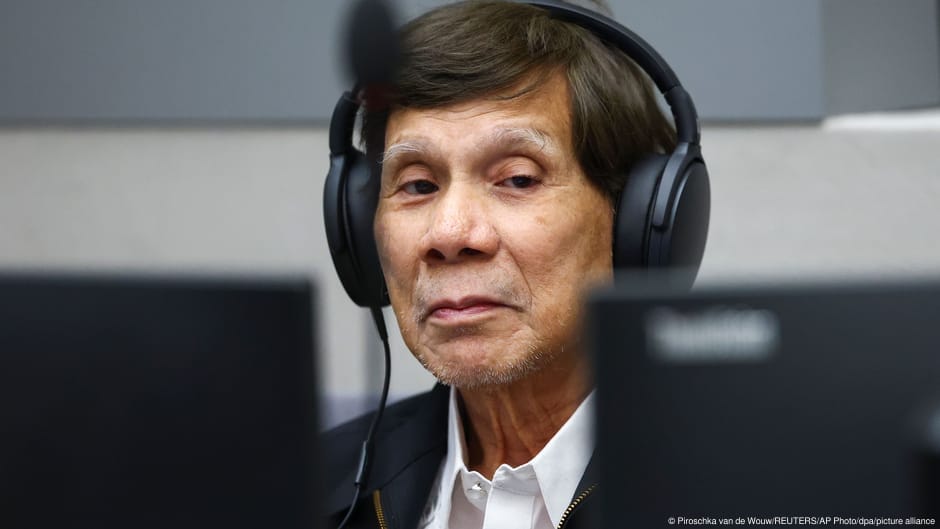
Former Philippine President Rodrigo Duterte will stand trial at the International Criminal Court (ICC) in The Hague on November 30, where he faces three counts of crimes against humanity linked to his bloody war on drugs.
(暂无翻译)
For the families of the thousands killed during his anti-narcotics campaign, the trial is a chance for justice that has eluded them at home.
(暂无翻译)
It is also a significant test of international justice at a time when the ICC faces increasing political pressure and questions about its ability to hold former heads of state accountable.
(暂无翻译)
Yet, Duterte, 81, is still a popular figure in the Philippines, where many still regard his violent crackdown as one of his presidency's greatest achievements.
(暂无翻译)
With his daughter, Vice President Sara Duterte, a frontrunner for the 2028 presidential election, the proceedings in The Hague could become a defining issue in the Philippines' next presidential election.
(暂无翻译)
Rodrigo Duterte was elected president in 2016 following an expletive-laden, populist campaign in which he openly promised to kill criminals and drug dealers.
(暂无翻译)
During his more than two decades as mayor of Davao City, he earned a reputation for transforming a notoriously violent city into a relatively safe one.
(暂无翻译)
To view this video please enable JavaScript, and consider upgrading to a web browser that supports HTML5 video Human rights groups, however, found systematic extrajudicial killings by the so-called Davao Death Squad, which ICC prosecutors allege Duterte helped establish and oversee.
(暂无翻译)
His disregard for political convention and promises of swift, uncompromising justice appealed to millions of Filipinos frustrated by corruption, crime and the perceived failures of successive governments.
(暂无翻译)
"Filipinos were deeply frustrated with everyday experiences of injustice and government inaction; [that] made them receptive to Duterte's promise of swift justice, even through extraordinary and violent means," Cleve Arguelles, a political scientist and CEO of Momentum Research, a pollster, told DW.
(暂无翻译)
After assuming the presidency, Duterte extended his Davao law enforcement model nationwide.
(暂无翻译)
Police launched sweeping anti-narcotics operations, primarily targeting impoverished urban communities, while suspected drug users and dealers were also killed by unidentified gunmen. Philippine authorities officially recorded 6,252 deaths during anti-drug operations, with police claiming to have acted in self-defense.
(暂无翻译) (暂无翻译)
Human rights organizations estimate the actual death toll at between 12,000 and 30,000. "Duterte's ruthless war on drugs was not simply a campaign against crime; it was a way of governing through killing," David Johnson, a professor of sociology at the University of Hawaii at Manoa, told DW.
(暂无翻译) (暂无翻译)
"The extraordinary violence he ordered and encouraged was sustained by a combination of extraordinary problems of impunity in the Philippine criminal justice system and deep failures of democracy in that country," Johnson said.
(暂无翻译)
"These conditions made extrajudicial killing politically useful even though it was ineffective as crime control." Duterte also used state power to intimidate and suppress wide sections of Philippine society, including opposition politicians, civil society groups, journalists, lawyers and judges, Diane Desierto, a professor of law and global affairs at the University of Notre Dame in the US, told DW.
(暂无翻译) (暂无翻译)
The deterioration of human rights under Duterte damaged the Philippines' international standing and strained relations with its traditional Western partners, particularly the United States under President Barack Obama and the European Union, which threatened to withdraw Manila's preferential trade privilege.
(暂无翻译)
Duterte left office in June 2022 as one of the most popular presidents in recent Philippine history.
(暂无翻译)
A survey conducted by pollster Social Weather Stations found that 88% of Filipinos were satisfied with his performance. His daughter was overwhelmingly elected vice president in May 2022, while their allies dominated that year's Senate elections.
(暂无翻译) (暂无翻译)
"Up to now, the Dutertes remain popular not in spite of the drug war but because of it," Arguelles said.
(暂无翻译)
Despite years of domestic and international scrutiny, Duterte remained at liberty for nearly three years after leaving office.
(暂无翻译)
The ICC opened a preliminary examination into the drug war in 2018, prompting Duterte to withdraw the Philippines from the court's founding treaty.
(暂无翻译)
A formal investigation began in September 2021. For much of his early presidency, President Ferdinand Marcos refused to cooperate with the ICC investigation.
(暂无翻译) (暂无翻译)
What changed was the breakdown of relations between the Marcoses and the Dutertes, two of the country's most powerful political dynasties.
(暂无翻译)
Marcos' father had ruled the Philippines as a dictator until he was overthrown in the 1986 People Power Revolution.
(暂无翻译)
To view this video please enable JavaScript, and consider upgrading to a web browser that supports HTML5 video The alliance that brought Marcos Jr. and Sara Duterte to power in 2022 unraveled spectacularly after November 2024, when the vice president claimed she had arranged for Marcos to be assassinated in the event of her own killing.
(暂无翻译)
She has since faced successive impeachment efforts.
(暂无翻译)
Philippine authorities arrested Rodrigo Duterte in March 2025, acting on an ICC arrest warrant issued four days earlier. In April this year, ICC judges confirmed three charges of crimes against humanity involving murder and attempted murder.
(暂无翻译) (暂无翻译)
The trial will begin with opening statements, followed by testimony from prosecution witnesses.
(暂无翻译)
The process is expected to be extensive, potentially running until 2028, the year of the next Philippine presidential elections.
(暂无翻译)
The Philippines is effectively confronting two different questions about the Duterte legacy: whether Rodrigo Duterte should be held criminally accountable for his presidency and whether his family should be entrusted with political power again, Arguelles said. Duterte-aligned senators implicated in the ICC investigation could face arrest and transfer to The Hague, while Sara Duterte is still a leading contender for the 2028 presidency, despite an ongoing impeachment trial over allegations of unexplained wealth that could see her barred from public office.
(暂无翻译) (暂无翻译)
Her brother, Sebastian Duterte, the mayor of Davao City, has also become a possible alternative presidential candidate.
(暂无翻译)
To view this video please enable JavaScript, and consider upgrading to a web browser that supports HTML5 video By portraying the ICC proceedings as foreign interference and political persecution, the Duterte family hopes to preserve the political capital accumulated during Rodrigo Duterte's presidency, Jayson Lamchek, a legal scholar at Western Sydney University, told DW.
(暂无翻译)
Before her father's arrest, Sara Duterte's performance and trust ratings had been declining amid allegations that she had misused confidential government funds.
(暂无翻译)
However, her ratings rebounded following his detention and have largely held up despite the ongoing impeachment controversies, Ronald Holmes, a political science professor at De La Salle University in the Philippines and president of polling firm Pulse Asia Research, told DW.
(暂无翻译)
"A conviction or prolonged trial near election season will likely turn the 2028 vote into a direct referendum on the Duterte legacy, either rallying sympathetic voters against perceived foreign and domestic persecution or galvanizing opposition forces around demands for accountability," Holmes said.
(暂无翻译)
For many Filipinos, however, the trial's significance goes well beyond the political rivalry between the two dynasties.
(暂无翻译)
"Rodrigo Duterte's trial in the ICC is a milestone not only for the victims and families of the war on drugs but for the entire country," Jean Encinas-Franco, a professor of political science at the University of the Philippines Diliman, told DW.
(暂无翻译)
"Duterte and his cabal ruled by fear and misogyny and held Filipinos under his iron grip," she said.
(暂无翻译)
"The Filipino people deserve an answer.
(暂无翻译)
The Filipino people deserve justice."
(暂无翻译)
仅供学习使用,如有侵权请联系删除 · 查看原文