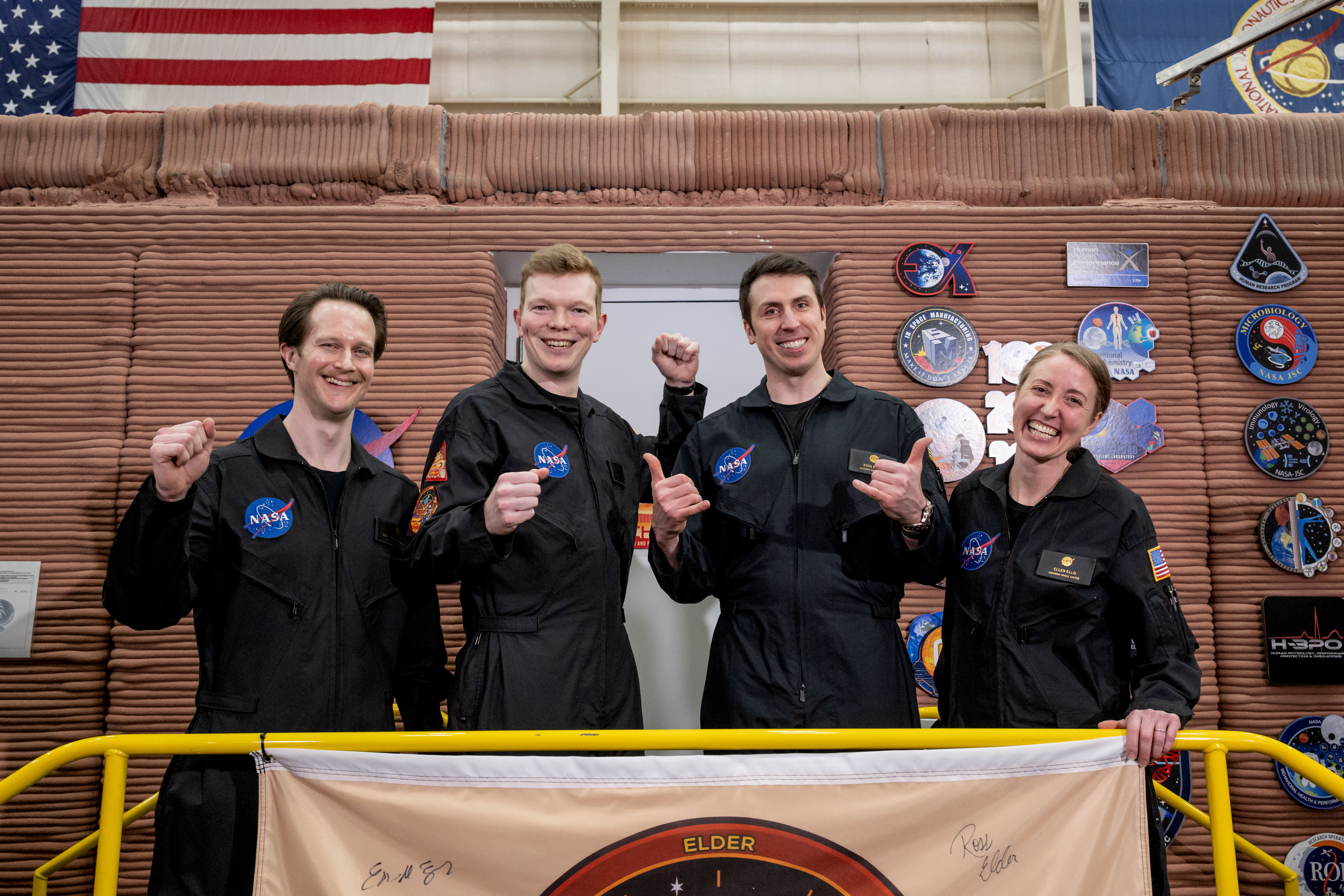
CHAPEA Mission 2 Crew Reflects After 378 Days on Simulated Mars
0 / 52
English
中文
After 378 days without windows, the sounds of the outside world, or real-time calls with family and friends, four research volunteers stepped out of NASA’s Mars Dune Alpha habitat on Oct. 31, completing the agency’s second yearlong Mars surface simulation.
(暂无翻译)
Ross Elder, Ellen Ellis, James Spicer, and Matthew Montgomery entered the roughly 1,700-square-foot, 3D-printed habitat at NASA’s Johnson Space Center in Houston on Oct. 19, 2025, for CHAPEA (Crew Health and Performance Exploration Analog) Mission 2.
(暂无翻译)
The crew participated in simulated Marswalks, robotic operations, habitat maintenance, exercise, and crop cultivation.
(暂无翻译)
“Their work means more than completing a mission,” said Johnson Director Vanessa Wyche. “It is about preparing for the challenges of human exploration beyond Earth, gathering the knowledge we need to protect crew health and performance, and paving the way for future missions to the Moon and, one day, Mars.” NASA astronaut Jack Hathaway put the crew’s time in isolation into perspective: While they were inside the habitat, he completed a 237-day mission aboard the space station and returned to Earth.
(暂无翻译) (暂无翻译)
During that same period, the Artemis II astronauts traveled around the Moon and set the record for the farthest humans have traveled from Earth.
(暂无翻译)
NASA also celebrated 25 years of continuous human presence aboard the International Space Station on Nov. 2, 2025. “The reality of what you guys did here required immense physiological and psychological strength, teamwork, and human grit,” Hathaway said.
(暂无翻译) (暂无翻译)
Supported by researchers and ground teams across the agency, the CHAPEA crew collected health and performance data while navigating limited resources and communication delays of up to 22 minutes each way.
(暂无翻译)
Elder brought a U.S.
(暂无翻译)
Air Force experimental test pilot’s approach to leading the crew. He found simulated Marswalks and robotic exploration “uncannily similar” to operating as part of a flight. From inside the habitat, crew members remotely operated a drone and a rover to survey terrain and identify or collect rock samples. The demanding Marswalk schedule also sharpened his understanding of the physical preparation future explorers will need.
(暂无翻译) (暂无翻译) (暂无翻译) (暂无翻译)
Preparing suits, completing airlock procedures, and making long traverses took time and stamina. He emphasized nutrition, exercise, and rest as essential to sustaining that pace. His steadfast leadership and mission focus drew praise at egress for keeping the team motivated and improving.
(暂无翻译) (暂无翻译) (暂无翻译)
For Elder, seeing his crewmates combine their strengths was a highlight of the mission. “The real magic has been the privilege and pleasure of seeing everyone come together, with the makings of one of the finest teams I’ve ever been a part of,” Elder said.
(暂无翻译) (暂无翻译)
Ellis, a U.S.
(暂无翻译)
Space Force officer with experience at the National Reconnaissance Office, brought a background in military operations and systems engineering. As medical officer, she helped organize biological sample collections and prepare supplies for the crew’s health research. As procedures became familiar, she emphasized the discipline needed to follow every step carefully.
(暂无翻译) (暂无翻译) (暂无翻译)
She also enjoyed solving problems with the tools available. “There is a kind of tactical creativity that I find energizing,” she said. Contributing to human spaceflight research helped sustain her motivation.
(暂无翻译) (暂无翻译) (暂无翻译)
So did the relationships with her crewmates. “It would be difficult to convince someone who has never lived in isolation that most days, I don’t feel isolated. I have three teammates that I rely on every day to get through the mission.” She also credited exercise, behavioral health, nutrition, and medical specialists for their coordinated support throughout the mission. “When I look back on the mission, the most salient point I’ve learned is that a future Mars crew requires a highly integrated ground team,” Ellis said.
(暂无翻译) (暂无翻译) (暂无翻译) (暂无翻译)
Spicer brought experience in satellite communications and spacecraft development to the habitat’s maintenance work.
(暂无翻译)
At egress, he was thanked for keeping its systems running smoothly and described as the “flight engineer extraordinaire and resident data scientist.” He compared the year to living aboard a submarine or boat, where limited supplies and space shaped daily decisions.
(暂无翻译)
The crew tracked consumables from dish soap to respirator filters and carefully managed food and water. The crew had access to resources that provided news, and Spicer was surprised by how little he missed constant news and social media updates.
(暂无翻译) (暂无翻译)
The break from distractions helped him focus on the mission. Inside the habitat, stories and jokes around the kitchen table brought laughter to demanding days.
(暂无翻译) (暂无翻译)
He told his crewmates they had made the year “not a chore, but a joy.” “We’re inspired every day knowing that the data we’re generating is informing Martian mission planning and increasing the safety, health, performance, and comfort of future Martian crews,” he said. Montgomery brought experience in hardware engineering, robotics, technology startups, and independent films.
(暂无翻译) (暂无翻译)
At egress, he was described as the “Swiss Army knife of crewmates” for his technical knowledge and problem-solving skills. He helped crewmates identify rock samples collected during simulated Marswalks and set up the habitat’s 3D printing capabilities.
(暂无翻译) (暂无翻译)
His background in indoor agriculture also carried into a seed-germination experiment that used a control and simulated Martian soil.
(暂无翻译)
Maintaining a consistent data set remained a priority. Montgomery learned to investigate anything that gave him pause, describing instances when speaking up helped identify concerns with equipment, safety, and data quality.
(暂无翻译) (暂无翻译)
He also learned to give himself more grace when an outcome fell short. At egress, he credited the crew’s different perspectives with producing solutions stronger than any member could have developed alone.
(暂无翻译) (暂无翻译)
“It’s really the people that make exploration possible,” he said. Two weeks of post-mission evaluations and debriefs will help researchers interpret the crew’s data alongside their experiences.
(暂无翻译) (暂无翻译)
The study builds on the first CHAPEA mission, which concluded July 6, 2024.
(暂无翻译)
Grace Douglas, CHAPEA’s principal investigator, said the research will help NASA weigh human health and performance risks against resources, including crew time, communication capacity, and food and water system designs.
(暂无翻译)
She also noted that many resource challenges facing space explorers mirror problems on Earth.
(暂无翻译)
Sara Whiting, CHAPEA project scientist, said the data comes as NASA plans how astronauts will live and work at the Moon Base, humanity’s first lunar outpost near the Moon’s South Pole. “This is really the now moment for this kind of data,” she said.
(暂无翻译) (暂无翻译)
仅供学习使用,如有侵权请联系删除 · 查看原文