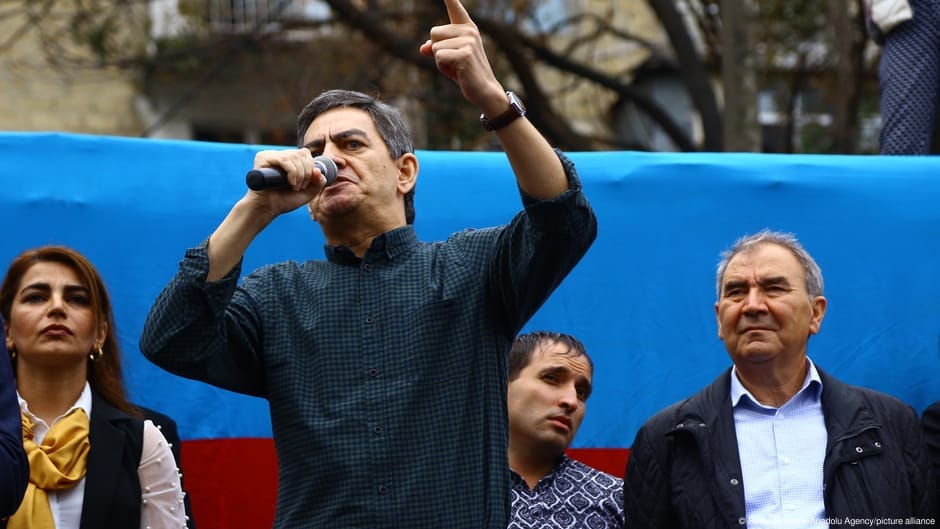
Azerbaijan's opposition leader Ali Karimli: A year behind bars
0 / 58
English
中文
Azerbaijani opposition leader Ali Karimli has been in prison since November 2025. Authorities accuse him of attempting to seize power by force, but human rights groups say his prosecution is politically motivated.
(暂无翻译) (暂无翻译)
A year after his arrest, Azerbaijani opposition leader Ali Karimli remains in prison.
(暂无翻译)
Karimli has denied charges of attempting to seize power by force, calling them politically motivated. He is the chairman of the Azerbaijani Popular Front Party (APFP), one of the country's main opposition parties.
(暂无翻译) (暂无翻译)
Karimli is on trial alongside Mammad Ibrahim, his longtime political adviser and a senior party official. Ibrahim has previously served time in prison. In 2016, he was sentenced to three years on hooliganism charges that Human Rights Watch described as spurious. He was detained on November 29, 2025, alongside Karimli.
(暂无翻译) (暂无翻译) (暂无翻译) (暂无翻译)
Azerbaijan's State Security Service has charged Karimli and Ibrahim under Article 278.1 of the Criminal Code, which covers actions aimed at forcibly seizing power or changing the country's constitutional order. A conviction could carry a prison sentence of 12 to 20 years, or life imprisonment.
(暂无翻译) (暂无翻译)
In a statement issued on February 12, the State Security Service alleged that Karimli had conspired with the former head of Azerbaijan's Presidential Administration, Ramiz Mehdiyev, and his allies to seize state power. The agency also linked the alleged conspiracy to interference by foreign intelligence services in Azerbaijan's political affairs.
(暂无翻译) (暂无翻译)
According to investigators, Karimli planned to exploit a mass rally in Baku in July 2020, originally held in support of the Azerbaijani army, to provoke unrest and seize the parliament and state television buildings. In a 15-page copy of a court motion obtained by DW from the APFP leadership, Karimli said he did not attend the rally and that his party was not involved in organizing it.
(暂无翻译) (暂无翻译)
Nazim Musayev, a lawyer representing Mammad Ibrahim, told DW that both defendants considered the prosecution politically motivated. Shortly after the arrest, Amnesty International demanded that Azerbaijani authorities release Karimli "unless they can demonstrate reasonable evidence of an alleged criminal offence."
(暂无翻译) (暂无翻译)
"Karimli's detention is the latest outrage in the ongoing consolidation of authoritarian practices in Azerbaijan," said Denis Krivosheev, Amnesty's deputy director for Eastern Europe and Central Asia, in a statement on December 1, 2025. "There appear to be no limits to the government's campaign to crush all political opposition and suppress all dissent in the country."
(暂无翻译) (暂无翻译)
In the court motion obtained by DW, submitted at a preliminary hearing on November 3, Karimli made no secret of his desire for political change in Azerbaijan. However, he insisted he has always opposed using violence to achieve it.
(暂无翻译) (暂无翻译)
"I accept only one way of coming to power — through democratic elections," Karimli wrote. The court rejected his call for charges to be dropped, but added the motion to his case file.
(暂无翻译) (暂无翻译)
Karimli also disputed the prosecution's claims about the National Council of Democratic Forces, an opposition coalition formed in 2013. He said the group was established openly to support a joint opposition candidate in the presidential election rather than to organize a coup.
(暂无翻译) (暂无翻译)
Karimli has also denied any cooperation with Mehdiyev, the ex-head of the presidential administration, saying the two have never met or communicated and that they represented opposing political positions for decades. Mehdiyev's lawyer told DW that his client also denies any connection to Karimli.
(暂无翻译) (暂无翻译)
The trial against Karimli and Ibrahim is held behind closed doors, with foreign diplomats also being denied entry. Lawyer Nazim Musayev said the closed proceedings were justified on the grounds that the case involved state secrets.
(暂无翻译) (暂无翻译)
In his motion, Karimli expressed little confidence in the fairness of the proceedings, argued that the case is intended to remove him from political life.
(暂无翻译)
To view this video please enable JavaScript, and consider upgrading to a web browser that supports HTML5 video Karimli's son Turkel, who lives in the United States, told DW that he last spoke to his father in late April or early May.
(暂无翻译)
He said his mother had also been denied phone calls and face-to-face visits since June. Turkel said his father's detention conditions had deteriorated sharply over the summer.
(暂无翻译) (暂无翻译)
Citing information received from lawyers, he said the authorities had temporarily stopped accepting food parcels from the family and restricted the amount of additional drinking water, which had been limited to 5 liters (1.3 gallons) a week. According to Amnesty International, Karimli reportedly fainted from severe dehydration during an August 6 court hearing. Food deliveries were later permitted again, and lawyers were told earlier this month that the water allowance would be increased to 10 liters a week.
(暂无翻译) (暂无翻译) (暂无翻译)
Karimli's legal team said he has lost considerable weight during his time in prison. Karimli has also complained of persistent noise disrupting his sleep, restrictions on family contact and physical exercise, worsening back pain and poor ventilation in his cell.
(暂无翻译) (暂无翻译)
Rights groups have raised concerns about Karimli's detention conditions, with Amnesty International warning that the reported lack of access to clean drinking water and ventilation could amount to torture or other ill treatment.
(暂无翻译)
Ibrahim's family is concerned that he is not receiving adequate medical treatment in the detention facility.
(暂无翻译)
His son Turan Ibrahim, who lives abroad, told DW that his father suffers from kidney problems and insomnia. According to Turan, doctors appointed by the authorities have examined his father several times.
(暂无翻译) (暂无翻译)
The family has also consulted outside doctors and is trying to arrange medication for him. Turan said communication and family visits were sometimes difficult for his father.
(暂无翻译) (暂无翻译)
Ibrahim's wife delivers food and supplies to the detention facility once a week, and is allowed to see him through a glass partition twice a month. Turan said his mother, who is unemployed and lives in rented accommodation, has also faced financial difficulties since her husband's arrest.
(暂无翻译) (暂无翻译)
Karimli has led the APFP since 2000.
(暂无翻译)
The party has continued operating during his detention. Rahim Hajiyev, a founding member of the party who now lives in France, told DW that the APFP had long relied on collective decision-making and that Karimli's arrest had not brought its organizational activities to a halt.
(暂无翻译) (暂无翻译)
However, he said party members, particularly those active on social media, continued to face short-term administrative detention.
(暂无翻译)
Hajiyev described Karimli's arrest as part of a broader campaign against political opposition. Karimli's detention has also drawn criticism from international organizations and European lawmakers.
(暂无翻译) (暂无翻译)
On October 8, the European Parliament adopted a resolution calling for the immediate and unconditional release of Karimli and other political prisoners in Azerbaijan.
(暂无翻译)
Lawmakers also urged the authorities to ensure adequate medical care, access to lawyers and contact with family members. Earlier this month, Karimli was awarded the 2026 Magnitsky Human Rights Award. Karimli's case was also raised at a joint press conference in Baku on November 18, attended by Azerbaijani Foreign Minister Jeyhun Bayramov and his German counterpart, Johann Wadephul.
(暂无翻译) (暂无翻译) (暂无翻译)
Asked about Karimli's arrest, Bayramov said that belonging to the opposition did not exempt anyone from legal responsibility. Bayramov maintained that the case was being handled in accordance with Azerbaijani law and said the court would make the final decision.
(暂无翻译) (暂无翻译)
仅供学习使用,如有侵权请联系删除 · 查看原文