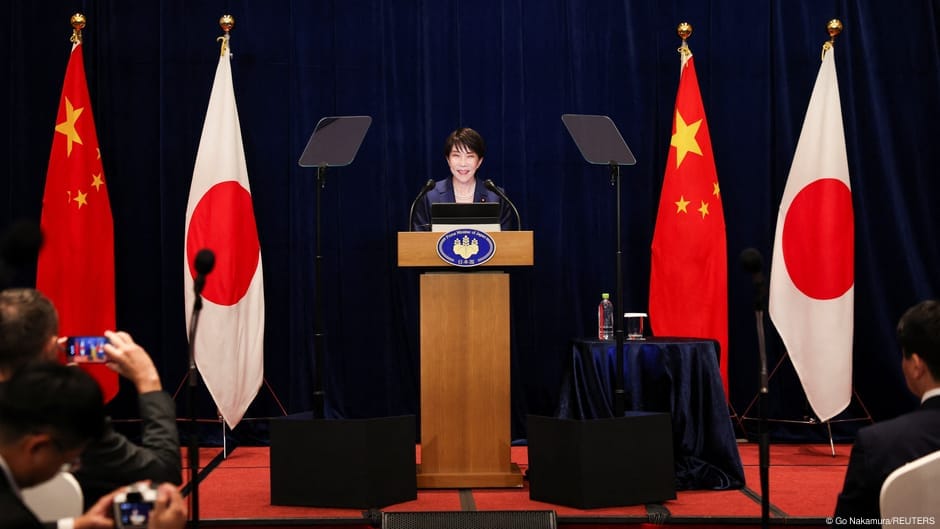
After Japan's APEC snub, what's next for its China ties?
0 / 38
English
中文
Japan has long-running concerns over Chinese military expansionism, and Beijing has bristled at Sanae Takaichi's comments on Taiwan. The frosty ties were on full display at the APEC summit.
(暂无翻译) (暂无翻译)
Japanese Prime Minister Sanae Takaichi received a cold shoulder from China during the recent Asia-Pacific Economic Cooperation (APEC) summit in the tech hub of Shenzhen.
(暂无翻译)
After Takaichi arrived in Shenzhen on November 18 for the two-day summit, there was an immediate issue when the mobile stairs to the door of her aircraft were some way short of the threshold, requiring her to hold on to the door frame to step down around 40 centimeters (about 15 inches) to the top step.
(暂无翻译)
It may have been completely inadvertent, but upon safely reaching the airport tarmac, her official welcome was decidedly low-key. There were no musical performances, no cheering crowds or traditional dances, which were laid on for many other APEC leaders as they arrived.
(暂无翻译) (暂无翻译)
Japan's Yomiuri newspaper reported on November 20 that when Takaichi met Chinese leader Xi Jinping at the dinner reception, "his reaction was cold." And while many other regional leaders managed at least a brief one-on-one with Xi on the sidelines of the main event, the Japanese delegation was not granted such access.
(暂无翻译) (暂无翻译)
"The level of frostiness from the Chinese side was on full display from the moment Takaichi's plane landed," said William Yang, a Taiwan-based analyst for the International Crisis Group.
(暂无翻译)
"I cannot think that the issue with the plane steps was anything other than deliberate and there was a huge contrast between the welcome she received and virtually everyone else," he told DW.
(暂无翻译)
Yang added that the ice didn't break when Takaichi tried to speak to Xi at the dinner reception and the entire occasion "just reflects the state of bilateral relations."
(暂无翻译)
China and Japan share a troubled history, marked by the Japanese invasion of China in the 1930s and the often brutal occupation of cities that were captured and subjugated.
(暂无翻译)
Chinese schoolchildren learn about the horrors of the Nanjing Massacre and the use of chemical and biological weapons by Japanese forces.
(暂无翻译)
Japan maintains that its repeated post-war apologies and massive economic aid that helped China to become the economic powerhouse it is today are overlooked amid the criticism.
(暂无翻译)
Diplomatic relations were normalized in 1972 and Tokyo pursued a policy of engagement over the following decades, although that came to a halt in the mid-2000s, points out David Adebahr, a professor of international relations and Asia-Pacific security policy at Kobe University.
(暂无翻译)
To view this video please enable JavaScript, and consider upgrading to a web browser that supports HTML5 video "China's rising military spending, the breakdown of talks over the East China Sea in 2006, and a resurgence of nationalism raised concerns even among Japan's more China-friendly diplomats, while defence analysts noted an increase in Chinese submarine activity near Japanese waters," he told DW.
(暂无翻译)
The nationalism on display during the 2008 Beijing Olympics, coupled with China's more assertive stance over the Senkaku Islands, which Japan has sovereignty over but which Beijing claims, accelerated this shift.
(暂无翻译)
Ties took a sudden nosedive in November 2025 when Takaichi responded to a question in Japan's parliament, the Diet, by saying that any "contingency” involving Taiwan would also inevitably threaten the national security of Japan.
(暂无翻译)
According to Adebahr, the Japanese leader was merely saying out loud what "had long been the internal logic of Japanese security planning."
(暂无翻译)
Nevertheless, Beijing has reacted with fury. China has demanded that Takaichi retract the statement and raised pressure on Japan by restricting exports of rare earth minerals critical to Japanese industry, banning imports of Japanese seafood and telling tourists to take Japan off their destination list.
(暂无翻译) (暂无翻译)
And while ruffled national feelings have been smoothed in the past with shows of reciprocal goodwill, China is standing firm on its demands this time.
(暂无翻译)
"From Tokyo's perspective, it is clear that Beijing believes it holds more cards than in the past," said Adebahr.
(暂无翻译)
"Today, Beijing has considerable leverage: Japan's dependence on Chinese rare earths; an increasingly visible military presence around Japan, sometimes in conjunction with Russia; and a US administration that has urged Tokyo to de-escalate rather than firmly backing it."
(暂无翻译)
Adebahr added that this left China with little incentive to offer Takaichi a face-saving compromise.
(暂无翻译)
However, he pointed out that Beijing's reliance on coercion could backfire by prompting Japan to increase defence spending and seek closer ties with other partners. Still, the Japanese leader finds herself in a difficult position, said analyst Yang.
(暂无翻译) (暂无翻译)
As a committed conservative who has talked tough on Beijing's rapid military buildup, its seizure of islands and atolls in the South China Sea and the inexorable pressure on Taiwan to capitulate and become one with mainland China, Takaichi cannot give in to Xi's demands for fear of losing face with her hardline base.
(暂无翻译)
"This is a major test of her abilities and wisdom as the nation's leader," Yang said.
(暂无翻译)
"She is walking a political tightrope between reducing tensions with China but, at the same time, preparing the nation and its allies for a potential contingency over Taiwan." "I foresee China maintaining its current approach, continuing to step up the pressure by limiting targeted exports and amplifying the assertion with Russia and North Korea that Japan is embracing remilitarization," he said.
(暂无翻译) (暂无翻译)
Yang added that Japan was likely to seek opportunities to signal goodwill and improve relations "in return for small-scale compromises."
(暂无翻译)
However, he said that a reset in the dynamics would depend on how the Trump administration shaped its foreign policy for the remainder of his presidency. Analyst Adebahr said that while he expects diplomatic relations to remain frosty, there are too many interdependencies for a full decoupling between China and Japan.
(暂无翻译) (暂无翻译)
"I would not be too pessimistic about the relationship, because in the medium term, trade, technology and critical minerals are now seen as security issues," he added.
(暂无翻译)
"Therefore, complex interdependence will prevent a return to the old pattern of keeping politics and economics separate." "While economic interdependence alone will not be enough to stabilize the relationship, full decoupling is highly unlikely, as transaction costs would be far too high for both sides," he said.
(暂无翻译) (暂无翻译)
To view this video please enable JavaScript, and consider upgrading to a web browser that supports HTML5 video
(暂无翻译)
仅供学习使用,如有侵权请联系删除 · 查看原文